As talk heats up about a bill hitting the Congress floor later this week to create a $700 billion package to assist the U.S. economy, many local Elon citizens are concerned the decision will burden them through taxes.
Ben Bernanke, chairman of the Federal Reserve, and other members of the Bush Administration are asking Congress to pass a plan that would assist the U.S. financial firms. It is likely to hit the floor this week.
Jerry Oakley, Elon resident and paint contractor, said the idea of the government intervening to help private businesses doesn’t sit right with him.
“First I thought it was kind of crazy for our government to step in there and do that,” Oakley said. “But they’re at that level, and that might not be the case.”
Oakley blames the investment bankers, who have large salaries and severance packages and sometimes work out of greed by telling people where to investment their money.
He wants them to find their own way out, since they are private entities.
“Nobody is going to bail me out if I’m in trouble,” he said.
The trickle-down impact the taxes may implement is something Elon University freshman Joanna Barratt think will likely happen.
She thinks there should be some aid, but not full assistance.
“With the debt of the federal government, it’s hard to say,” Barratt said. “There should be some help, but with the federal debt, it shouldn’t be a huge, huge amount.”
Elon University Economics Professor Jim Barbour said the American people have an unhealthy relationship with greed, credit and debt.
But he said a bailout will be best.
“It’s a lot like hunting flies with a cannon,” he said. “You’ll kill the flies but you also make a huge hole in the wall.”
While the price tag for the bailout ring ups to an average of $2,333 for every U.S. citizen, this may not be as big of a financial impact on them as they may think, he said.
“It might actually be a benefit,” he said. “We need to keep in mind that these assests aren’t going to be worth zero. The tax burden won’t be $700 billion.”
Watch Elon University freshman Joanna Barratt give her opinion on the bailout:
Covering the weather or local government on a regular basis can become mundane or repetitive, but the information presented in local reporting and beats is pertinent to the community. While the occasional controversy may draw attention to a specific topic, regular reporting can be equally as enthralling as long as writers take the steps necessary to make their stories pop.
One instance of outstanding reporting is The Philadelphia Inquirer reporter Russell Eshleman Jr.’s story, “Even for Trees, Age Could Have Its Privileges.” Here, Eshleman uses humor, word play and short stories to keep readers in check. In The Conta Costa Times, reporter John Simerman’s story, “Watching Williams Die,” gives a descriptive lead of watching a man be executed on death row. Immediately the entire audience picks up on the tone and continues since they are curious as the process unfolds, since only a very select few beings have witnessed such an event.
But despite the author’s specific style of writing or how they decide to present their story to the readers, there are several aspects that consistently make local reporting and beats a better quality:
Shoe-leather journalism
This includes remembering to not only be informative but entertaining. It’s important to get local concerns across, hit the streets and talk to average citizen and consider the audience. This is the most important aspect of this style of writing; any newspaper can cover a similar story, but it is the job of the beat reporter to illuminate the local side. They’re covering a specific region: How will the town be affected by this? Why should they care? How do they receive the issue?
It’s all about action, reaction and interaction. People want to know how this is going to impact their life. The Commercial Appeal reporter Bartholomew Sullivan uses many of these tactics in his story, “Tornado sneaks into Manila, killing 2 kids just as sirens wail.” He talks to over 10 sources to tell their accounts of the tornado and to display an array of impacts across the community.
Making it relatable
The easiest way to make something relatable is to always remember to keep the reader in mind. By sharing a story, giving an allusion to pop culture or using a metaphor or analogy, the audience has an easier time relating. “By the time she got there, the wall of her mother’s house had been torn away, but her children had escaped injury wedged between a bed and a couch,” Sullivan wrote. In this small town where the tornado struck, everyone was a witness to the damage.
They may have even known the family that lost members. But they also all remember their gut reactions to hearing the sirens themselves and may know someone who had a similar survival situation like being wedged between a bed and a couch. He also uses vivid detail, such as “he crunched through hallways strewn with glass,” to connect with readers. Any audience member who had damage to their house knew how they felt when they heard that sound the next morning while surveying damage. Being able to evoke those feelings through writing is what sets Sullivan apart.
Breaking it down
By talking to the best sources and using the most credible information, any story becomes stronger. Sullivan put the most important facts of his story first, starting with the loss of the two children’s lives, the resulting damage and the play-by-play of how the storm turned into a tornado. He then went on to detail several personal accounts that people could relate to.
In Simerman’s story, he illuminated both sides of the issue. He gave descriptions of the person who was advocating for William’s innocence as well as the stepmother of a victim slain by Williams. By presenting each side, the reader is torn: Is the founder of this epic gang really guilty? But at the same time how do you cope with the pain of losing a loved one to such a ruthless crime?
Presenting information
In “The cases your judges are hiding from you” by Seattle Times reporters Ken Armstrong, Justin Mayo and Steve Miletich, they broke the story of how the town’s local courts were hiding information and files from the public. They use repetition and quick blows to present new information in a relevant, stunning manner. “Document after document, file after file, has been sealed — and sealed improperly — by the judges and court commissioners of King County Superior Court. A wrongful-death lawsuit against Virginia Mason Medical Center? Sealed. A lawsuit accusing a King County judge of legal malpractice? Sealed. A lawsuit blaming the state’s social-services agency for the rape of a 13-year-old girl? Sealed.”
Even though this is an instance where new information is surfacing and that is what a majority of the public is going to be most interested in, the way they structure the story draws readers in and makes them think twice about their community and even themselves.
Other article cited or related to local and beat reporting include:
He counted the number of times on his fingers. “One, two, three, four, five, six,” sociology professor Tom Arcaro said. In his 22 years at Elon, Arcaro has moved offices six times. But that number is about to climb to seven, when his current space in the Holland House is physically picked up and moved next to Johnston Hall on South Campus next summer.
“We knew all along it was moving when we started building the Academic Pavilions,” Arcaro said. “[Holland House] is in the footprint of the final building.”
Though there had been speculation for years, the news only officially broke last week.
Brad Moore, assistant director of construction management, said moving the building will provide additional office space on that part of campus and open up the view into the Academic Village from Haggard Avenue.
Senior Amanda Gross relaxes in front of Holland House before heading to her next class. The sociology building used to be to the right of the building before it was moved to accommodate the William Henry Belk Pavilion, which is currently there.
“A general contractor will work closely with a house mover and the railroad to move it from one site to the other,” he said.
While all of the plans are tentative and will not be finalized until the spring, Moore said there is currently no development plans for the existing site.
Currently, the Periclean Scholars department, leisure and sports management department, faculty and staff lounge and a few administrators from the admissions department are housed there.
Associate Provost Nancy Midgette, who is responsible for assigning departments and individuals to their buildings and offices, said she does not know where any of the current departments of Holland House will move to once the house is gone.
“The admissions piece will be moving into the Powell Building,” she said. “I don’t know exactly where we’re going to move the others. I’m going to do my best to have it sorted out before the truck gets here to move the house.”
The new location will serve as offices for the Alumni Relations team and the Alumni Center, Director of Alumni Relations Sallie Hutton said.
Moore said the move will also allow University Advancement to expand within Johnston Hall.
Because of department changes, the need for more or different space and new buildings being built, there is a constant shuffle around campus, Arcaro said.
“By their nature, college campuses are dynamic, living things,” Arcaro said. “Change is going to happen and you have to have trust in the people that steward the institution to make the right decision on how the growth and change occurs.”
But the entire house won’t make the trip.
“The back half is not going,” Arcaro said. “No more than half of the footprint that sits here now will be the footprint when it gets on the other side of campus. That’s partially because it would be bloody impossible to move the whole thing.”
The house, which once served as the president’s personal home, has experienced several additions since first being constructed. To ditch part of the house and go back to its original form is as logical a move as anything else, Arcaro said.
Arcaro said he had neutral feelings about the move since the change that usually happens at Elon has historically been for the better.
The McMichael Science Building now sits where a large Victorian house was knocked down.
“We had a lot of mashing of the teeth when it was being torn down,” he said.
But at the end of the day, no one will argue that McMichael is in the wrong place, Arcaro said.
“Certainly the history that goes into this house is worth preserving by moving it,” Arcaro said. “The institution of higher education is an organic entity that moves and changes and that’s the natural way of things.”
On Friday evening it wasn’t the line out the door at the re-opening of Lighthouse Tavern that had everyone rushing in a panic. Instead, it was the dozens of cars patiently waiting to fill up their tanks at both the Elon and surrounding Burlington gas stations.
With Hurricane Ike expected to crash into the Gulf Coast later in the evening, many students, faculty members and community residents took their cars to the nearest gas station to fill up before gas prices sky rocketed.
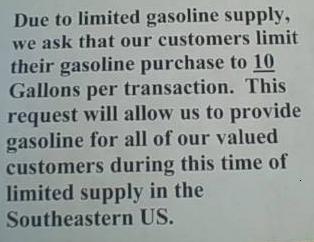
This sign was posted at each pump at the B.P. Kangaroo Gas Station in Elon, N.C. While the station asked customers to limit themselves to 10 gallons, many did not.
The Gulf Coast comprises one of the world’s largest concentration of oil refineries and many companies were shutting down Friday while their employees evacuated, according to MSNBC.com.
Gas prices rose by 11 cents on Thursday when Ike began to make a more direct approach towards the Texas area.
Junior Grace Trilling was one of the dozens of Elon students flocking to the B.P. Kangaroo gas station to fill her tank before Ike hit land Friday night or Saturday morning.
“I’m trying to get some cheap gas before it runs out,” she said. “The lines are crazy. We all came here.”
Trilling said she heard gas was supposed to hit $5 a gallon overnight and that other gas stations had already run out of fuel.
The Kangaroo was requesting that each purchase be kept to under 10 gallons in an effort to conserve enough gas for everyone. However, they did not put a physical cap on the limit.
English Professor Brian Crawford filled up at the same station as Trilling after seeing the price hike in surrounding gas stations.
Even though he is filling up today, he views this circumstance as a notion that the country needs to take a different path regarding energy sources.
“I think we should live closer to where we work. I think we should ride bikes,” Crawford said. “If the gas prices go up to $10 a gallon, maybe this country will decide to put in a real public transportation infrastructure.”
Gas prices rose at the B.P. Kangaroo from $3.59 on Friday to $3.99 on Saturday.
Video by Derek Noble.
Around 5 p.m. on Friday the line at the B.P. Kangaroo gas station in Elon, N.C. had long lines that required drivers to wait for about 10 minutes before they had access to the pump.
Elon University English Professor Brian Crawford made a dash for the pump after seeing the prices at other gas stations.
Elon University Junior Grace Trilling said people outside of Elon were coming to use the gas station. She heard that some gas stations in Burlington had already run out of gas due to the high demand.
Elon University Juniors Patrick McCabe [talking] and James Wesley Lynch [on cell phone] assist junior Grace Trilling with filling up her tank before filling up their own. McCabe said he was willing to pay up to $5 a gallon for gas, but that it would force him to drive his car “very rarely.”
The Zone may soon be serving up more than SubLive, open mic and exam jam nights. In the latest move to makeover Moseley Center, the administration is considering constructing a Starbucks where The Zone is currently located.
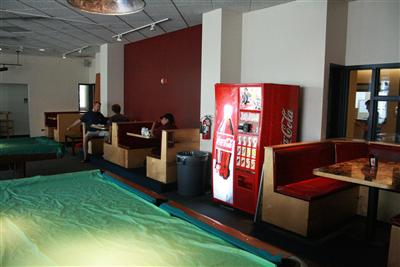
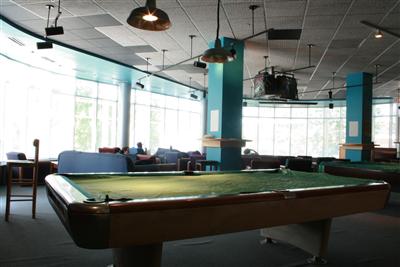
If the Elon administration approves the project, a Starbucks may be appearing in The Zone in Moseley Center. The project, which would take between 22 and 24 weeks to complete from planning to opening, has already been tested in student focus groups. Photos by David Wells.
Director of Auxiliary Services Vickie Somers said they are in the process of working with Starbucks, which has a very specific process to follow.
“We have met with their representatives so they could evaluate the space and they think a Starbucks would work well in the space,” she said.
The next steps require the university to provide information about the electrical, plumbing and mechanical setup of the room. Electronic drawings prepared by an architect that detail the space, called CAD drawings, have also been submitted.
“Starbucks will study these drawings and submit planning documents to Elon along with a cost to proceed with the project,” Somers said. “It is at this stage that Elon will decide whether or not to proceed with the project.”
If Elon approves the project it will take between 22 and 24 weeks to follow the design to completion.
“From information received from students in focus groups we were told a coffee shop in this location will be well received,” Somers said. “Starbucks is a well-known brand among our students but, if the cost is prohibitive, we will certainly consider other vendors.”
The Zone currently does not see much student traffic during the day.
As with all new projects in dining services, sustainability is always taken highly into consideration, Somers said.
“In some ways it was a really important thing to have happen because it will make them aware of and sensitive of the world and make them be able to be responsible for their behavior.”
From 2-5 p.m. every Thursday a farmer’s market is held next to the church on Williamson Ave. On Sept. 4 I talked to a couple of the “farmers” and some of their buyers to figure just why they are at a farmer’s market at Elon and not at a Food Lion.
Check out their responses:
The marketplace occurs in Elon every Thursday afternoon. Many students, as well as local residents, stop by to pick up local, organic food.
Elon resident, Zo, sells shirts and games she made herself at local street fairs. She likes the atmosphere of the marketplace, even though she never knows if she’ll sell anything or if she’ll sell everything.
Burlington resident, Fabian Lujan, uses his large backyard to create grow and create his products. These range from honey to fruit to handmade soap.
Bobby Kirk comes from his farm in Mebane to sell his produce. It is there that he grows all of his fruits and vegetables. He said that while he currently has a lot of repeat customs at the Elon Market, his business is doing better as the market gets more popular.
More citizens asked for input before final plot is chosen
by Andie Diemer
September 3, 2008
After years of waiting, to be or not to be is no longer the question. Elon Mayor Jerry Tolley and the town board have already been given the green light on constructing the first public library in the Town of Elon, but just one problem troubles them: Where to start digging?
The city lobbied for a library 12 years ago but did not get approved, said Judy Cobb, director of Alamance County public libraries, said. The decision to construct now follows the approval of the Alamance County Board of Commissioners to build a new public library branch to serve western Alamance County.
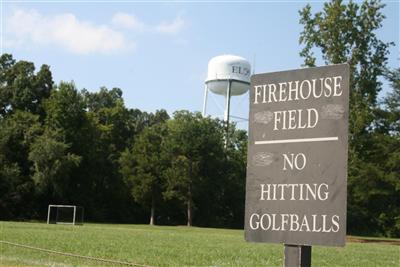
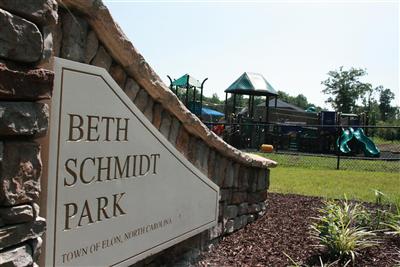
The town board has narrowed down the location of Elon’s first library to two locations: Beth Schmidt Park and Comer Field, better known as Firehouse Field. Photos by David Wells.
Although this decision was made over a year ago, Aldermen Mark Greene said the planning process has been intense and has required a lot of community input.
“There’s been some feedback, but not widespread,” Greene said at a Sept. 2 Elon Town Hall meeting.
After careful research and feedback, the debate has been narrowed down to two potential locations: Beth Schmidt Park on Cook Road and Comer Field, better known as Firehouse Field, across from the fire station on Williamson Avenue.
The building program is funded by a planning grant from the Federal Institute of Museum and Library Services in conjunction with the State Library of North Carolina, according to the Town of Elon’s Web site.
Alderman Davis Montgomery said a portion of the grant was set toward hiring Phillip Barton, a leading consultant for planning libraries in North Carolina.
In February residents were invited to two gatherings, directed by Barton, to discuss the final touches of the project such as potential locations and uses for the library. They were also encouraged to offer any additional input.
“We’re blessed with having the problem of having two excellent sites for this library,” Montgomery said. “We really, as best as we could, tried to look at all the various angles.”
The Board of Alderman postponed voting on the issue indefinitely.
Sheri James, an Elon resident and member of the appearance commission for Elon, said she is concerned about the university location. She said the roads are already experiencing excess traffic and she doesn’t want to concentrate everything downtown, especially since the town is growing more toward the north.
Also, the park would provide a quieter, more serene atmosphere, she said. But she just wants it done right.
“Apparently the citizens of Elon are going to be paying for a lot of stuff pretty soon,” James said. “I really want a library, but I don’t want to pay extra taxes.”
While a $500,000 private donation has already been made, the only other money set aside for the library is about $80,000 for books, according to Cobb.
The construction plans to ring up to about $200 a square foot, resulting in roughly a $3 million investment by the community. Though the burden of the price tag for the physical building would come from the citizens of Elon regardless of location, the cost of staffing and running the library would fall on the county.
Montgomery said his team researched recently built libraries around the area before looking into the possibilities and weighing the pros and cons of the two final sites.
The board and residents discussed parking situations, proximity to streets, design and architecture, pathways, traffic congestion, how it would fit in with the community and safety concerns for each plot of land.
“[Planned development in Comer Field] would have activity that would allow for a more vibrant downtown: restaurants, ice cream shops, drugstores,” Ken Mullen, Elon representative and assistant vice president for business and finance, said. “We thought a library would be an excellent addition to that. It would bring a lot of people to the area.”
This includes a range of citizens, from Boy Scout troops to Elon University students to seniors from Twin Lakes.
Montgomery said from the 50 or so e-mails he has received with citizen input, an overwhelming amount of citizens are in favor of the park location. He was hoping to hear from more people.
“I think people like the vision of the park and library side by side and the synergy that it ties together,” Montgomery said. “I would have liked to hear more about people talking about the park location. It would be interesting to do a town survey on that location.”
Alderman Ron Klepcyk expressed concern that widening the space by the park in order to construct the building would place the road closer to the playground and community center, which poses a safety issue.
“I think we need to have other conversations with Department of Transportation about those issues to guarantee safety,” Klepcyk said. “That’s really critical in this planning process.”
They also took the land-use plan of the town into consideration.
While Comer Field currently belongs to Elon University, Mullen said the school is eager to share the property.
Similar to the situation with the current fire station northeast of campus on Powerline Road, the university would “loan” the property to the Town of Elon, with a restriction on the deed or a written contract that states in the occasion of the library no longer existing the land would be returned to the university.
The library is also being built with expansion in mind, whether it’s up or out, Montgomery said.
The 13-acre university area, which has already been appraised, would need to be configured for a water and sewer system first, Mullen said. But he also said the university is very close, if not completely ready, to being the planning process.
“If you come to us and take us up on the offer, we’re ready to pretty much go,” he said. “You know how the university works. We’d put 100 percent of our efforts behind that and go as quickly as we could.”
He said when the planning for the field is complete it would take about two years from the time ground is broken to the time the ribbon is cut.
Mullen said regardless of the library being constructed or not, the university plans to develop the land soon.
Since the meeting was an agenda session no vote was taken. Tolley moved to pass putting the issue on the Sept. 9 agenda to be voted for. He wanted to allow time for more research.
“I don’t think that we feel we have all the information we need to make that decision,” Trolley said. “But we really enjoyed everybody’s input.”
Greene suggested sending out a survey with the pros and cons of each location attached to get a better idea of the citizens’ stances.
Cobb thinks the Beth Schmidt Park location will come out on top, but in her mind it’s all about just getting the library built.
“It was denied in the ‘90s,” Cobb said. “Folks have waited a long time for this library.”
Those students who normally take home a Dean’s List status may need to work a little harder now to achieve that same standard every semester.
Last year the Academic Standing Committee altered the criteria for being named to the Dean’s List, which recognizes and encourages excellence in academic work. The change, which was applauded by Elon faculty, is set to go into affect starting this semester, according to Registrar Mark Albertson.
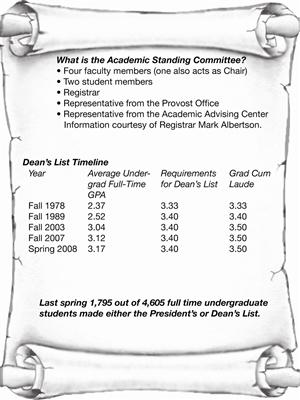
The list normally encompasses those students who had no grade below a B– and had a GPA of at least 3.4 in a minimum of 12 semester hours. The university has changed the standards to stay the same as far as receiving no grade below a B– in at least 12 semester hours, but have required students to have a 3.5 GPA.
“The Academic Standing Committee and faculty decided it was time to raise our honors distinction, since we felt that an honor should be an honor,” Albertson said. “We don’t change many rules or regulations that often.”
To be honored on the Dean’s List students now have to have at least a 3.5 GPA with no grade below a B- while enrolled in 12 semester hours. Graphic by Miriam Williamson.
The change follows 19 years of not altering the criteria to receive the distinction and the steady increase of a stronger student body.
The administration also felt it was necessary to raise the standard since the criteria for graduating Cum Laude was raised to a 3.5 GPA in 2003.
Albertson said this was an important transition since conceivably a person could make the Dean’s List every semester of their time at Elon, but still not be able to graduate with honors.
Last spring 39 percent of full time, undergraduate students made either the Dean’s or President’s List. Had the new regulation been instated then, only 33 percent of students would have qualified.
“We just felt we needed to raise it so getting on lists would carry some distinction to qualify,” Albertson said. “You want it to have a luster.”
After reviewing the policies in place at other peer institutions across the nation the administration knew a change was necessary since in a few years it was possible for about half of the student body to be qualifying for either the Dean’s or the President’s list.
While only about five percent of students would have been affected by the change last semester, Albertson is hoping the new standard will push more students to strive for it.
The change was voted for unanimously at a faculty meeting and no one spoke out against it, including the two students on the Academic Standing Committee, he said.
However, no changes have been made to achieving President’s List status, which requires no grade below an A– in a minimum of 12 semester hours.
Albertson said the percentage of students that fall within that honor has not been growing.
Classes passed on a Pass/Fail basis or classes with grades of “S,” “WD” or “W” are not included in Dean’s List or President’s List eligibility.
Jason Lee Dunn, an Elon resident, was arrested and charged with a peeping Tom incident in Myrtle Beach. He allegedly took a photograph of a boy underneath a bathroom stall at a mall.
Elon resident charged with peeping Tom allegation
Not linked to last year’s string of exposure incidents
by Andie Diemer
Sept. 3
An Elon resident charged with a peeping Tom incident July 19 in Myrtle Beach, S.C., is not considered a link to any previous indecent exposure or peeping Tom cases around Elon.
Director of Campus Safety and Police Chuck Gantos said Jason Lee Dunn, 29, of West Haggard Avenue, does not fit any of the descriptions or patterns of behavior from the complaints filed around campus last spring.
Dunn was arrested and charged after the father of a 12-year-old boy said he saw the suspect take a picture of his son underneath a bathroom stall at a shopping mall, according to a Horry County police report.
The boy’s father, Jon Cockerham, who had taken both of his sons into the bathroom, confronted Dunn. After Dunn denied taking the pictures, Cockerham followed him into the parking lot and called the police, according to the report.
Police confiscated Dunn’s phone, where they found a photograph of the boy in the stall.
Dunn, a first time offender, was released on $5,000 bail from J. Reuben Long Detention Center July 21, the Times-News reported.
Since the incident took place outside of Elon’s jurisdiction, Elon police are not investigating Dunn, but are assisting by providing or following up on possible leads, Gantos said.
“He was charged with taking pictures of an adolescent male, which doesn’t fit the profile of the individual that was doing indecent exposure in front of females,” Gantos said. “I don’t think that links it.”
Gantos said campus security forwarded a few leads to the local police department, where they are still being pursued.
Last spring semester, several cases were reported of a man who approached women and exposed himself or masturbated.
No more indecent exposure instances have been reported at Elon, Gantos said. He credits the publicity about the effort to find those responsible for ending the string the exposures.
“He probably either quit for a while or went somewhere else, which is not usually uncommon for someone of this character,” he said. “But I think the thing we need to be concerned about is that he’ll eventually come back, so we need to find out who he his and get him off the streets.”
Gantos said there are about 150 registered sex offenders that currently live in Alamance County, and that it is important to remember to be careful.
“These people are not just in Alamance County or North Carolina,” Gantos said. “It’s nationwide. You always have to be cautious and use good judgment and good common sense.”


 andie diemer