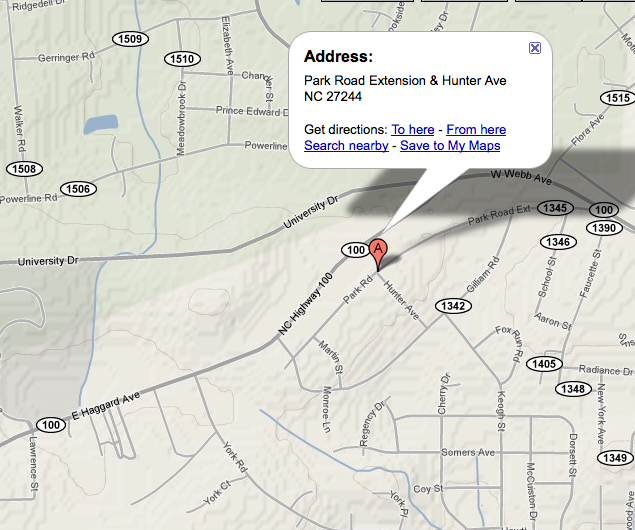
Graff’s body was found early Tuesday morning at Park Road Extension and Hunter Avenue.
by Andie Diemer
Sept. 30, 2008
A 21-year-old man lying on railroad tracks was struck and killed by a freight train early this morning. The university confirmed he was not an Elon student.
Ronald Alan Graff was lying on the railroad tracks and hit by a Norfolk Southern train traveling west at 2:16 a.m., according to the Times-News.
His body was found at Park Road Extension and Hunter Avenue.
The Times-News reported that the conductor saw someone lying on the tracks but could not halt the train in time.
Police did not release where he lived.
Officials are looking for any extenuating circumstances surrounding Graff’s death.
To report any information regarding this incident, call Burlington police at 229-3530.
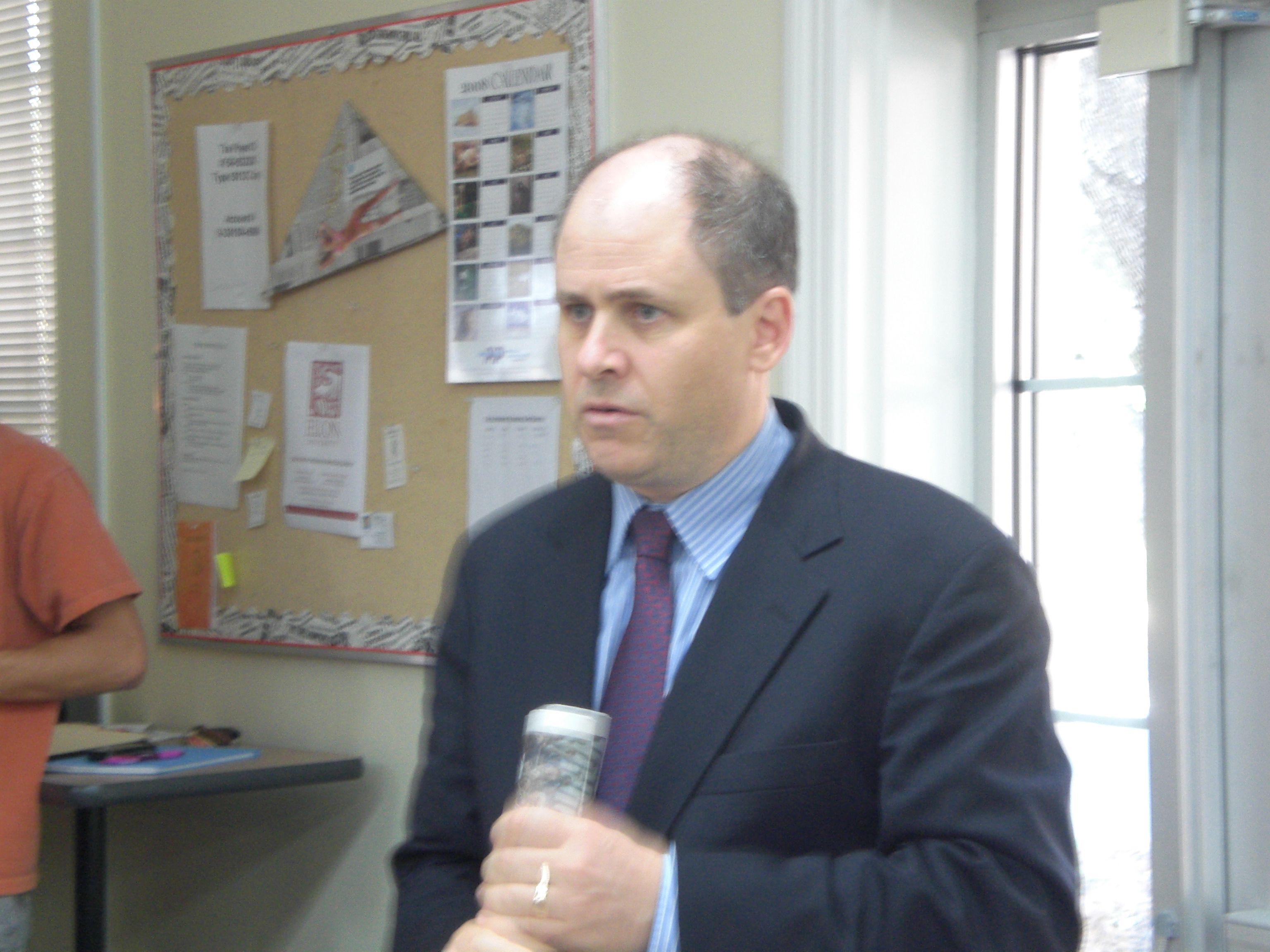
Jonathan Alter spoke with the staff of the student newspaper, The Pendulum, inbetween his question-and-answer session and speech at Elon University on Sept. 29.
by Andie Diemer
Sept. 29, 2008
Jonathan Alter, a senior editor at Newsweek since 1991, spoke to the Elon community on Monday night about the election campaigns, the current status of the country and the issues the next president will face.
Students, faculty, staff and community members crowded into McCrary Theatre to hear Alter speak. While Alter was pleased with the turnout, he wasn’t surprised. He said he has seen large crowds and a similar interest and intensity at every venue he’s visited this year.
“People are taking this choice seriously,” he said.
Prior to his speech in McCrary, Alter sat down for an exclusive interview with The Pendulum. He shared his insights on the youth vote, last Friday’s debate, Sarah Palin and more. To read the full interview, go to http://www.elon.edu/pendulum.
Diemer: This is the seventh election you’ve covered for Newsweek. Has anything surprised you? Alter: Everything is always surprising me. That’s what keeps it fun, is that every year there are big changes in American politics. I think particularly in this election year, we’ve seen a number of major changes. To give you a quick example, four years ago, hard as it is to believe, YouTube hadn’t even been invented yet. It didn’t start until 2005.
In the past, campaign finance was dominated by fat cats, big contributors. This year you have the Obama campaign — about half of their contributors are giving under $200 and large numbers under $100. They have about 2.5 million contributors, which just dwarfs anything we’ve seen in the past, so that’s very surprising.
D: Why are young people more interested in this election? A: I think there are three reasons why they are turning out in greater numbers this year. First is how close the 2000 election was, when they were very young, and they remember that. The second is the aftermath of Katrina and 9/11 and the recognition that the stakes are very, very high for who the president should be. The third is the emergence of Barack Obama, who has a very unusual and particular appeal to younger voters.
D: Why are kids so drawn to Obama? A: There is sort of a combination of a freshness and a coolness to Obama, a hipness that just intrigued young people from the minute they laid eyes on him.
D: You’ve mentioned a lot of differences between this campaign and past ones. Do you see any similarities? A: I think the most significant one is it’s still very possible to get the campaign off of the major issues that will face the new president, distracted onto lipstick-on-a-pig-type issues that are really just campaign flaps or gaps or charges and countercharges of the day that don’t really have anything to do with the actual issues that the next president will face.
D: What messages have been put forward by each camp that have had a lasting, negative effect on the other side? A: I think that the basic Obama message that John McCain is maybe a hero, but he’s out of touch for the 21st century, is a resonant message and a problem for John McCain. I think John McCain’s message that Barack Obama is not passionate enough about real people’s problems and maybe a little too inexperienced to handle certain international issues — that will continue to be a problem [for Obama]. I think a deeper problem for Obama is when McCain and Palin push these class buttons: ‘He’s not like you; he’s the other; he’s exotic; he doesn’t really come from the same place that you are.’ Some of that may be a little bit racial, but some of it is not racial. It’s just a depiction of him as having a different kind of experience.
D: On the topic of the debate, do you think there was a clear winner? A: I think they both did quite well. I don’t think there was a clear winner. There was a clear loser, and the loser was Sarah Palin. The reason that she was the clear loser is that both McCain and Obama set a very high standard for knowledge and fluency about the issues. If she just goes into her debate this week with a lot of canned sound bites, a lot of attacks on Obama, and doesn’t show a command of the issues, she will be compared unfavorably both with Joe Biden and, more importantly, with Obama and McCain in terms of her readiness to be president.
D: Since Palin was picked, there has been a lot of information, negative information, that has surfaced. Do you think the McCain camp is rethinking its choice? A: I don’t think they are — they put so many chips on Sarah Palin and they came up such a big winner at the Republican convention, that I think that they really believe their faith in her and her abilities, and that she has real talents, politically, and they will be validated by her performance.
Do they wish she had done better in the interview with Katie Couric? I’m sure they do, but I don’t think that they’re reassessing their decision to pick her and I think there’s zero chance of her being taken off the ticket.
D: What are the most important issues in this campaign? What does the next administration need to focus on? A: In many ways, there’s only one issue, I believe, for the next president. The reason there’s only one issue is that almost every other really important issue flows out of that one issue. That one issue is restoring America’s global leadership, restoring America’s prestige in the world.
On the range of really big international problems, whether it’s dealing with a nuclear Iran, winding down the war in Iraq, dealing with North Korea, dealing with climate change, with terrorism, with AIDS — these are all international problems. If we don’t restore America’s leadership, we will not be able to address those problems. So, to me the preeminent question is which of these two men can move most effectively to reestablish our leadership.
D: Who do you think is going to come out on top? A: I honestly think it could still go either way, and I’ve been saying for the last several weeks that it was 50/50. I would now put it at about a 55/45 edge for Barack Obama, but that still gives McCain a very, very good chance to win this election. While I would maybe bet $5 on Obama, I wouldn’t bet $10.
Whitney Bossie contributed to this article. Watch to hear Alter’s tips to make it big in the news industry:
A panicky wave washed over campus last week when word leaked that the Recording Industry Association of America (RIAA) had been investigating file sharing at Elon. While the rumors ranged from company officials physically showing up on campus to being able to backtrack downloaded songs from years ago, Chris Fulkerson, assistant vice president for technology, knew one thing was true: Illegal downloading has to stop.
While Fulkerson is normally notified of these types of infractions on a regular basis, the first two weeks of September marked a period of excess use that merited a severe wake-up call. Fifteen reports of downloading specific songs, which were chosen by the RIAA to trace, were reported by the RIAA to Elon during a three-day period.
“I let out that we had 15 notices and so people are getting nervous,” Fulkerson said.
He said the RIAA has never stepped onto campus, nor do they need to. Instead, they simply use the internet to jump on music-sharing sites, such as Limewire, and pick targeted songs to track.
Fulkerson said the first round of high hits may not be aimed as much at students as it was at the administration as a warning to curb the problem before more serious steps are taken.
The school used to keep logs of complaints for three days, but when the Higher Education Reauthorization Act was passed in August the school became required to keep logs for about two weeks.
“We must comply,” he said. “They don’t take that well [when we tell them no]. That is part of why the new act went into effect — a lot of schools have been doing that.”
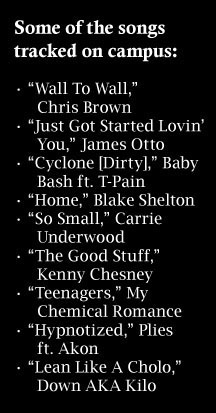
The RIAA searched for these specific songs on Elon’s campus. Fulkerson said they don’t always seek the most current or popular songs.
Fulkerson said it means several hours of work for him. After the RIAA reports specific IP addresses from computers that are illegally file sharing, Fulkerson’s networking people have to go through all the logs and match them up.
“We trace it back to the dorm, to the port, to the wireless connection,” he said. “We try to find out who it is or the general area of where it came from.”
If the RIAA sends a notice they usually ask for names to be turned over, Fulkerson said.
“Our policy has been if we get asked we’ll turn them over,” he said. “We’ve been asked and we’ve said we couldn’t identify the person.”
While no students have been turned over to the RIAA yet, Fulkerson said tracking the exact IP address to a specific student could definitely happen. In that case, they would also be handed off to Judicial Affairs.
“We aren’t required by law to turn the names over, but we do cooperate with the RIAA,” he said.
Fulkerson said he is going to send an e-mail to a specific building in Danieley Center to notify them of activity that has been located in their area.
“I’m not going to go any further,” he said. “[I’m going to say] it was traced to your building. Stop it.”
The new requirement of logging in with an Elon username and password on all campus computers or wireless plays a partial role in downloading illegal items, since now all guests and users have to register before accessing the Internet.
“By keeping guests off our network, we know it is,” Fulkerson said. “Even the guests who come on our network have to log in.”
If caught, it’s $150,000 per infraction, no matter how many songs they find on your computer.
“What they do is they go for the maximum and then settle. That’s the way they have been doing it,” Fulkerson said. “And they’re quite up front with everybody saying were going to make an example out of these students, they’re the ones that got caught.”
Fulkerson said students are taking a chance by breaking the law.
“The recording industry is becoming more aggressive at prosecuting and they’re getting better at finding people and they’re getting the government on their side by being very sympathetic about their industry. It’s the law.”
“In some ways it was a really important thing to have happen because it will make them aware of and sensitive of the world and make them be able to be responsible for their behavior.”
More citizens asked for input before final plot is chosen
by Andie Diemer
September 3, 2008
After years of waiting, to be or not to be is no longer the question. Elon Mayor Jerry Tolley and the town board have already been given the green light on constructing the first public library in the Town of Elon, but just one problem troubles them: Where to start digging?
The city lobbied for a library 12 years ago but did not get approved, said Judy Cobb, director of Alamance County public libraries, said. The decision to construct now follows the approval of the Alamance County Board of Commissioners to build a new public library branch to serve western Alamance County.
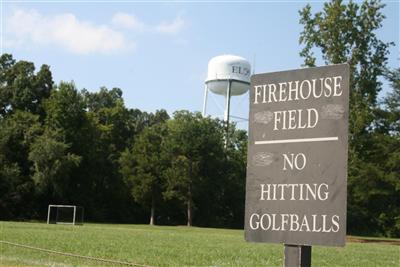
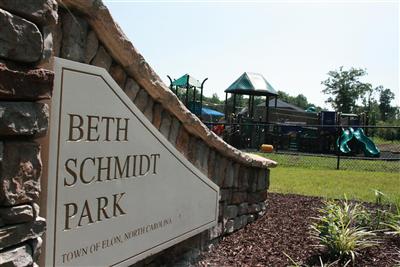
The town board has narrowed down the location of Elon’s first library to two locations: Beth Schmidt Park and Comer Field, better known as Firehouse Field. Photos by David Wells.
Although this decision was made over a year ago, Aldermen Mark Greene said the planning process has been intense and has required a lot of community input.
“There’s been some feedback, but not widespread,” Greene said at a Sept. 2 Elon Town Hall meeting.
After careful research and feedback, the debate has been narrowed down to two potential locations: Beth Schmidt Park on Cook Road and Comer Field, better known as Firehouse Field, across from the fire station on Williamson Avenue.
The building program is funded by a planning grant from the Federal Institute of Museum and Library Services in conjunction with the State Library of North Carolina, according to the Town of Elon’s Web site.
Alderman Davis Montgomery said a portion of the grant was set toward hiring Phillip Barton, a leading consultant for planning libraries in North Carolina.
In February residents were invited to two gatherings, directed by Barton, to discuss the final touches of the project such as potential locations and uses for the library. They were also encouraged to offer any additional input.
“We’re blessed with having the problem of having two excellent sites for this library,” Montgomery said. “We really, as best as we could, tried to look at all the various angles.”
The Board of Alderman postponed voting on the issue indefinitely.
Sheri James, an Elon resident and member of the appearance commission for Elon, said she is concerned about the university location. She said the roads are already experiencing excess traffic and she doesn’t want to concentrate everything downtown, especially since the town is growing more toward the north.
Also, the park would provide a quieter, more serene atmosphere, she said. But she just wants it done right.
“Apparently the citizens of Elon are going to be paying for a lot of stuff pretty soon,” James said. “I really want a library, but I don’t want to pay extra taxes.”
While a $500,000 private donation has already been made, the only other money set aside for the library is about $80,000 for books, according to Cobb.
The construction plans to ring up to about $200 a square foot, resulting in roughly a $3 million investment by the community. Though the burden of the price tag for the physical building would come from the citizens of Elon regardless of location, the cost of staffing and running the library would fall on the county.
Montgomery said his team researched recently built libraries around the area before looking into the possibilities and weighing the pros and cons of the two final sites.
The board and residents discussed parking situations, proximity to streets, design and architecture, pathways, traffic congestion, how it would fit in with the community and safety concerns for each plot of land.
“[Planned development in Comer Field] would have activity that would allow for a more vibrant downtown: restaurants, ice cream shops, drugstores,” Ken Mullen, Elon representative and assistant vice president for business and finance, said. “We thought a library would be an excellent addition to that. It would bring a lot of people to the area.”
This includes a range of citizens, from Boy Scout troops to Elon University students to seniors from Twin Lakes.
Montgomery said from the 50 or so e-mails he has received with citizen input, an overwhelming amount of citizens are in favor of the park location. He was hoping to hear from more people.
“I think people like the vision of the park and library side by side and the synergy that it ties together,” Montgomery said. “I would have liked to hear more about people talking about the park location. It would be interesting to do a town survey on that location.”
Alderman Ron Klepcyk expressed concern that widening the space by the park in order to construct the building would place the road closer to the playground and community center, which poses a safety issue.
“I think we need to have other conversations with Department of Transportation about those issues to guarantee safety,” Klepcyk said. “That’s really critical in this planning process.”
They also took the land-use plan of the town into consideration.
While Comer Field currently belongs to Elon University, Mullen said the school is eager to share the property.
Similar to the situation with the current fire station northeast of campus on Powerline Road, the university would “loan” the property to the Town of Elon, with a restriction on the deed or a written contract that states in the occasion of the library no longer existing the land would be returned to the university.
The library is also being built with expansion in mind, whether it’s up or out, Montgomery said.
The 13-acre university area, which has already been appraised, would need to be configured for a water and sewer system first, Mullen said. But he also said the university is very close, if not completely ready, to being the planning process.
“If you come to us and take us up on the offer, we’re ready to pretty much go,” he said. “You know how the university works. We’d put 100 percent of our efforts behind that and go as quickly as we could.”
He said when the planning for the field is complete it would take about two years from the time ground is broken to the time the ribbon is cut.
Mullen said regardless of the library being constructed or not, the university plans to develop the land soon.
Since the meeting was an agenda session no vote was taken. Tolley moved to pass putting the issue on the Sept. 9 agenda to be voted for. He wanted to allow time for more research.
“I don’t think that we feel we have all the information we need to make that decision,” Trolley said. “But we really enjoyed everybody’s input.”
Greene suggested sending out a survey with the pros and cons of each location attached to get a better idea of the citizens’ stances.
Cobb thinks the Beth Schmidt Park location will come out on top, but in her mind it’s all about just getting the library built.
“It was denied in the ‘90s,” Cobb said. “Folks have waited a long time for this library.”
 andie diemer