Election campaigns full of surprises for news veteran Jonathan Alter
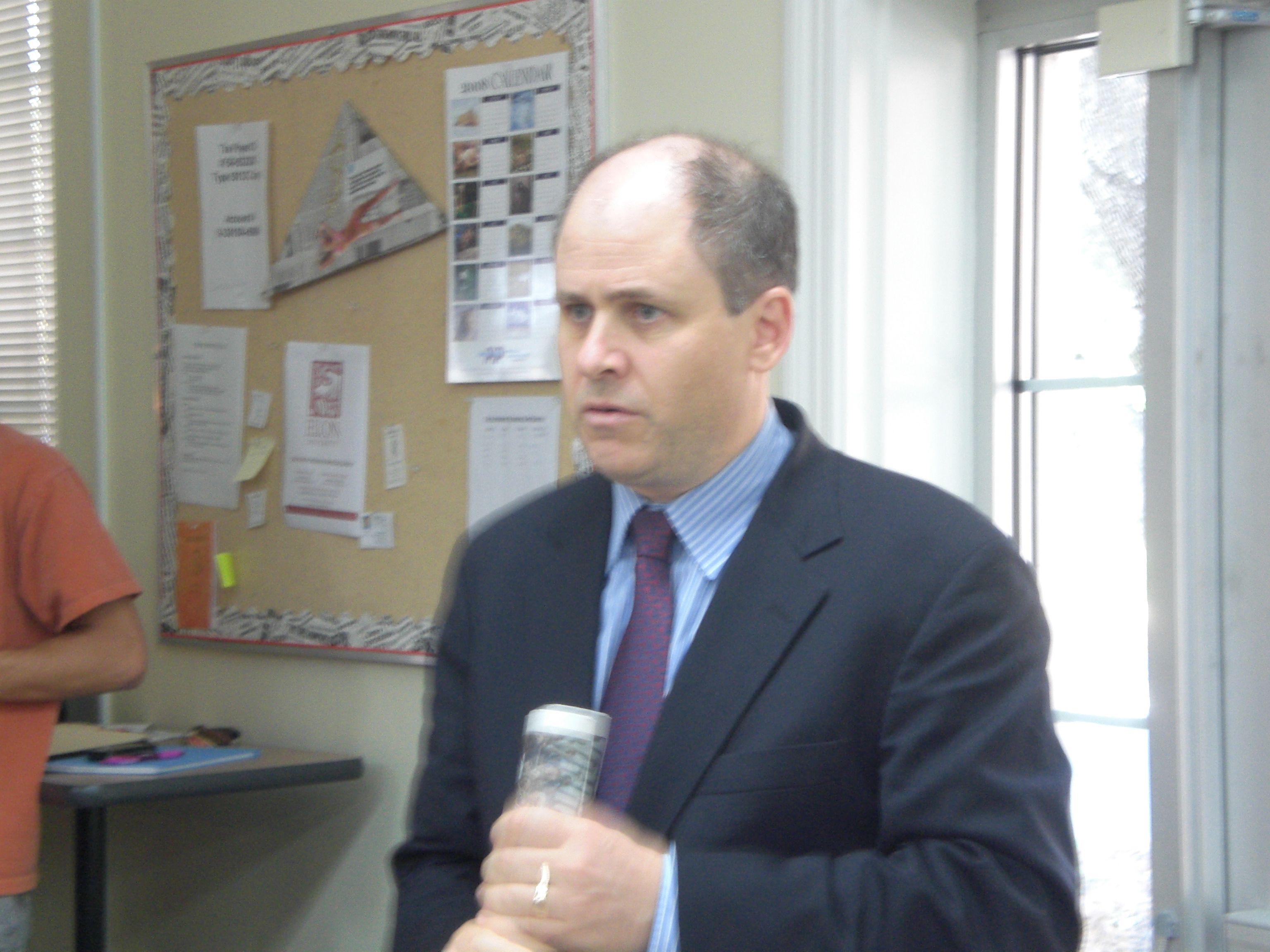
Jonathan Alter spoke with the staff of the student newspaper, The Pendulum, inbetween his question-and-answer session and speech at Elon University on Sept. 29.

by Andie Diemer
Sept. 29, 2008

Jonathan Alter, a senior editor at Newsweek since 1991, spoke to the Elon community on Monday night about the election campaigns, the current status of the country and the issues the next president will face.

Students, faculty, staff and community members crowded into McCrary Theatre to hear Alter speak. While Alter was pleased with the turnout, he wasn’t surprised. He said he has seen large crowds and a similar interest and intensity at every venue he’s visited this year.

“People are taking this choice seriously,” he said.

Prior to his speech in McCrary, Alter sat down for an exclusive interview with The Pendulum. He shared his insights on the youth vote, last Friday’s debate, Sarah Palin and more. To read the full interview, go to http://www.elon.edu/pendulum.

Diemer: This is the seventh election you’ve covered for Newsweek. Has anything surprised you?
Alter: Everything is always surprising me. That’s what keeps it fun, is that every year there are big changes in American politics. I think particularly in this election year, we’ve seen a number of major changes. To give you a quick example, four years ago, hard as it is to believe, YouTube hadn’t even been invented yet. It didn’t start until 2005.

In the past, campaign finance was dominated by fat cats, big contributors. This year you have the Obama campaign — about half of their contributors are giving under $200 and large numbers under $100. They have about 2.5 million contributors, which just dwarfs anything we’ve seen in the past, so that’s very surprising.

D: Why are young people more interested in this election?
A: I think there are three reasons why they are turning out in greater numbers this year. First is how close the 2000 election was, when they were very young, and they remember that. The second is the aftermath of Katrina and 9/11 and the recognition that the stakes are very, very high for who the president should be. The third is the emergence of Barack Obama, who has a very unusual and particular appeal to younger voters.

D: Why are kids so drawn to Obama?
A: There is sort of a combination of a freshness and a coolness to Obama, a hipness that just intrigued young people from the minute they laid eyes on him.

D:
You’ve mentioned a lot of differences between this campaign and past ones. Do you see any similarities?
A: I think the most significant one is it’s still very possible to get the campaign off of the major issues that will face the new president, distracted onto lipstick-on-a-pig-type issues that are really just campaign flaps or gaps or charges and countercharges of the day that don’t really have anything to do with the actual issues that the next president will face.

D: What messages have been put forward by each camp that have had a lasting, negative effect on the other side?
A: I think that the basic Obama message that John McCain is maybe a hero, but he’s out of touch for the 21st century, is a resonant message and a problem for John McCain. I think John McCain’s message that Barack Obama is not passionate enough about real people’s problems and maybe a little too inexperienced to handle certain international issues — that will continue to be a problem [for Obama]. I think a deeper problem for Obama is when McCain and Palin push these class buttons: ‘He’s not like you; he’s the other; he’s exotic; he doesn’t really come from the same place that you are.’ Some of that may be a little bit racial, but some of it is not racial. It’s just a depiction of him as having a different kind of experience.

D: On the topic of the debate, do you think there was a clear winner?
A: I think they both did quite well. I don’t think there was a clear winner. There was a clear loser, and the loser was Sarah Palin. The reason that she was the clear loser is that both McCain and Obama set a very high standard for knowledge and fluency about the issues. If she just goes into her debate this week with a lot of canned sound bites, a lot of attacks on Obama, and doesn’t show a command of the issues, she will be compared unfavorably both with Joe Biden and, more importantly, with Obama and McCain in terms of her readiness to be president.

D: Since Palin was picked, there has been a lot of information, negative information, that has surfaced. Do you think the McCain camp is rethinking its choice?
A: I don’t think they are — they put so many chips on Sarah Palin and they came up such a big winner at the Republican convention, that I think that they really believe their faith in her and her abilities, and that she has real talents, politically, and they will be validated by her performance.

Do they wish she had done better in the interview with Katie Couric? I’m sure they do, but I don’t think that they’re reassessing their decision to pick her and I think there’s zero chance of her being taken off the ticket.

D: What are the most important issues in this campaign? What does the next administration need to focus on?
A: In many ways, there’s only one issue, I believe, for the next president. The reason there’s only one issue is that almost every other really important issue flows out of that one issue. That one issue is restoring America’s global leadership, restoring America’s prestige in the world.

On the range of really big international problems, whether it’s dealing with a nuclear Iran, winding down the war in Iraq, dealing with North Korea, dealing with climate change, with terrorism, with AIDS — these are all international problems. If we don’t restore America’s leadership, we will not be able to address those problems. So, to me the preeminent question is which of these two men can move most effectively to reestablish our leadership.

D: Who do you think is going to come out on top?
A: I honestly think it could still go either way, and I’ve been saying for the last several weeks that it was 50/50. I would now put it at about a 55/45 edge for Barack Obama, but that still gives McCain a very, very good chance to win this election. While I would maybe bet $5 on Obama, I wouldn’t bet $10.

Whitney Bossie contributed to this article.

Watch to hear Alter’s tips to make it big in the news industry:

House says ‘no’ to $700 billion bailout, Dow posts record losses

Graphic courtesy of MCT Campus.

by Andie Diemer
Sept. 29, 2008

The House of Representatives rejected the proposed $700 billion plan to bail out the U.S. economy late Monday afternoon. The emergency rescue package, which aimed to buy bad mortgages to help stabilize the economy, failed by 23 votes, sending the Wall Street Stock Exchange plummeting before the vote was even complete.

The bill, which lost 228 to 205, would have been the Treasury Department’s biggest intervention since the Great Depression. The Dow Jones industrial average closed at 777 points, the biggest closing point drop in history.

About 60 percent of Democrats backed the bill while only about a third of Republicans supported it.

Jim Barbour, associate professor of economics at Elon University, said this is a situation where action needs to be taken.

“There is going to have to be some sort of intervention take place here,” Barbour said. “There’s lot of ways this could be accomplished and this bill is only one of them.”

The plan would have allowed the government to spend up to $700 billion to rescue banks and other weakening firms of assets, backed by home mortgages that are foreclosing at a record rate.

“This is a bill that is basically bailing out those people that have undertaken risky investments and those investments have not paid off and they are looking at great loss,” he said. “They are looking at assistance from the government to protect their fortunes.”

Because a bank can never be assured they are going be repaid for any loan, the situation only escalated when the banks don’t trust each other, he said.

“Unfortunately, these top-flight financial institutions are now risky loans in themselves,” Barbour said.
President Bush addressed the public before the debate began, urging lawmakers to support the plan even through resistance from taxpayers and voters.

Bush said the vote was necessary to protect the economy and in an attempt to negate claims that the bill would only benefit Wall Street’s top firms, Bush said “A vote for this bill is a vote to prevent economic damage to you and your community,” according to the Washington Post.

Barbour blames the complications on American’s unhealthy relationship with credit, weather on a personal or national level.

He said a substitute bill has probably already been created and will be put forward soon.

“I don’t like the idea that we’re in this situation, but it doesn’t change the fact that we are,” Barbour said.
This can trickle down to local communities, where people may no longer be able to get a much simpler loan for items such as automobiles.

“This affects everything that you do that involves borrowed money,” he said. “Which includes everything from running your credit card to buy a coffee to borrowing the money to buy a house when you graduate and everywhere in between.”

Caroline Fox also contributed to this article.

Free kittens look for new parents outside popular coffee shop

by Andie Diemer
Sept. 29, 2008

Burlington resident Dave Fitzgerald and his children, Anya, 3, and Thomas, 6, squatted outside Acorn Coffee Shop in downtown Elon today offering free kittens to the community.

Their mother cat had five kitten seven weeks ago.

Junior Sydney Little spotted the kittens, adopted one and left to pick up cat litter to give her new pet a home.

Watch to see what Thomas has to say about the kittens:

Politics with a side of pork

North Carolina Republican candidates gather for barbecue at Elon Law

by Andie Diemer
Sept. 28, 2008

Friday night the Elon Law Republicans hosted “Pork and Politics,” where the community was invited to eat Hursey’s Bar-B-Q, listen to local and state Republican North Carolinian candidates and watch the first presidential debate live.

“It can be hard for local candidates to have a forum to speak about why they are running and how they would contribute,” Summer Nettleman, Elon Law student and event coordinator, said. “We wanted to be able to bring local Republicans together.”

Each candidate addressed the audience on why he or she should be elected. Fourteen candidates were represented.

Laura Wiley for N.C. House of Representatives:
Wiley is up for re-election for District 61 in the N.C. General Assembly House. During her time there she helped pass a child predator act and helped rewrite, redefine and increase penalties for stalking.

This November, she is hoping for a republican house majority.

“We have a lot left to do,” Wiley said. “We’ve got to work together. We don’t win elections by ourselves, we win them by your hard work.”

John Blust for N.C. House of Representatives:
Representing District 62, Blust is running for re-election. He wants new ethical standards to be implemented this time around.

“Today we have our terrorism, we have our war on terrorism but our biggest challenges are from within,” he said. “For you people going into law, remember that the fundamental reason for the law is something called justice.”

Hugh Webster for 13th District Representative:
After spending 12 years in the North Carolina Senate, Webster is still firm in his platform.

“I support real tax reform, folks,” he said. “And I support, more than anything else, integrity in government.”

He is also an advocate for offshore drilling and cited a price drop when President George W. Bush opened up drilling recently.

“I care how you vote,” he said. “Anybody that knows me knows what I stand for.”

Elizabeth Dole for Senator:
Bill Fields spoke on behalf of Sen. Elizabeth Dole, who is running for re-election. He said as Americans, North Carolinians are at war on the borders, with the democrats and the energy crisis.

“We’re also at war in our pocketbooks,” Fields said. “It’s the Democrats who want a government that’s all intrusive.”

He said Dole promises to provide less government and fewer taxes.

“If it’s war that the Democrats want,” he said, “it’s war they’ll get.”

John Odom for N.C. Insurance Commissioner:

Odom has a business background but said he saw the need for a new commissioner in Raleigh.

He said he plans to streamline the departments, which employ 492 workers.

“[This will] make it easier for you as a consumer so that everybody in the state of North Carolina has a low rate and is taken care of,” he said.

Eddie Southern for Guilford County Commissioner:
Southern plans to work on education and on bringing down the tax rate.

“We [have to] get our children educated and work on the fact that we have gang and violence problems in Guilford County,” Southern said. “We [have to] work to get some republicans that have backbone in the government.”

He also wants to bring safety back to the neighborhoods.

“What I want to do is work to make our lives better,” he said.

Pat McCrory for Governor:
Penn Broyhill acted as a stand-in speaker for Pat McCrory, who is currently the mayor of Charlotte.

“We are in a tough, tight race,” Broyhill said. “We’re fighting a political machine that can control Raleigh.”

He said McCrory wants to clean up Raleigh and the state as whole.

In December of 2007, McCrory became the only Charlotte mayor in history to be elcted to a seventh term. He was originally elected in 1995.

McCrory was raised in Guilford County and graduated from Catawba College in 1985.

Betty Brown for District Court Judge:
With more than 24 years of experience in the court system, Brown said she will continue to treat everyone who appears before her with dignity and respect.

“I wanted to take that experience, knowledge, skills and wisdom that I’ve learned over the years and take it to the court bench so I could continue to serve the citizens of Guilford County,” Brown said. “I will be fair, impartial and thorough in my deliberations.”

Bob Edmunds for N.C. Supreme Court:
Running for his second term, Edmunds said the Supreme Court is a court that does affect everyone, even students.

“One thing I hope, above all else is that the voters will compare their candidates,” he said.

He said he feels he is the highest-qualified candidate, since he is the only one that has been a judge, a partner in a law firm and is certified in law.

Edmunds was elected to the Supreme Court for his first term in 2000. He has also served on the North Carolina Court of Appeals and as a U.S. federal prosecutor.

Robert Enochs for District Court Judge:
Enochs has a background in accounting and has practiced criminal defense and domestic and civil law.
He also worked as the Guilford County Assistant District Attorney for 13 years.

“I’ve appeared in district court rooms on both sides of the aisle, which gives me unique sight,” he said. “Experience matters.”

Susan Bray for District 18 Judge:
Up for re-election, Bray said she was happy to be out in the community, talking about her campaign.

“We who are judges and judicial candidates appreciate the opportunity to meet voters because we get left out of a lot of forums,” Bray said. “I really would like to win it.”

Dan Barrett for N.C. Court of Appeals:
During his race for governor, Barrett physically walked across North Carolina.

Five pairs of shoes, 582 miles, 20 pounds and an unsuccessful bid for governor later, he is now running for the Court of Appeals.

“My judicial philosophy is conservative. That means I will not legislate from the bench, I will be tough on crime and I will be independent, fair and impartial,” he said. “I will do the job you sent me to do.”

Jim Rumley for House District 59:
Rumley said he is asking the community to vote for him so he can “unseat one of the most ineffective legislators in the House today.”

Questioning the ethics and integrity of his opponent Maggie Jeffus, Rumley said he will help North Carolina in a new way.

“I’m going to do what’s right,” Rumley said. “We’re going to do the right things when I get in the house.”

Jewel Ann Farlow for N.C. Court of Appeals:
Farlow, who has practiced law for more than 20 years and worked on civil and criminal cases, said it’s important to elect a practitioner like herself.

“I bring 20 years of practical, real-life experience to the bench,” she said. “I want to make a difference to the people and to the state of North Carolina.”

She pledged to be a full-time judge and not hold to any special interest groups or lobbyists.

“I believe that the law should be applied fairly and impartially. I will make my decision based upon the law,” Farlow said. “If elected I will be working for the people of the state of North Carolina every day of the week.”

Forty applications received for provost position so far

by Andie Diemer
Sept. 28, 2008

Elon has hired a search consultant to help wade through the more than 40 applications already received for the position of provost and vice president for academic affairs.

The search is underway after Gerry Francis, the current provost and vice president, announced his move to the office of executive vice president.

Elon created a Provost Search Committee compromised of faculty, staff and students to ensure students have a say in the new provost.

Tom Henricks, professor of sociology, and Paul Parsons, dean of the School of Communications, are co-chairs of the committee.

In early September, the committee hosted three faculty and staff forums to help develop a better understanding of the expectations for the new provost.

“This is the recruitment period right now,” Parsons said. “The search consultant is contacting individuals and taking queries from them and we’re sort of in this pattern until late October when the committee will review the applications to date and select about six or more for preliminary interviews.”

The committee expects to receive  somewhere between 80 and 100 applications.

The provost oversees academic affairs, admissions and financial planning, student life, intercollegiate athletics, institutional research, sponsored programs and cultural affairs and also serves as assistant secretary and treasurer of the Board of Trustees.

Caroline Fox contributed to this article.

Excessive illegal file sharing has students, legislation out of tune

by Andie Diemer
Sept. 24, 2008

A panicky wave washed over campus last week when word leaked that the Recording Industry Association of America (RIAA) had been investigating file sharing at Elon. While the rumors ranged from company officials physically showing up on campus to being able to backtrack downloaded songs from years ago, Chris Fulkerson, assistant vice president for technology, knew one thing was true: Illegal downloading has to stop.

While Fulkerson is normally notified of these types of infractions on a regular basis, the first two weeks of September marked a period of excess use that merited a severe wake-up call. Fifteen reports of downloading specific songs, which were chosen by the RIAA to trace, were reported by the RIAA to Elon during a three-day period.

“I let out that we had 15 notices and so people are getting nervous,” Fulkerson said.

He said the RIAA has never stepped onto campus, nor do they need to. Instead, they simply use the internet to jump on music-sharing sites, such as Limewire, and pick targeted songs to track.

Fulkerson said the first round of high hits may not be aimed as much at students as it was at the administration as a warning to curb the problem before more serious steps are taken.

The school used to keep logs of complaints for three days, but when the Higher Education Reauthorization Act was passed in August the school became required to keep logs for about two weeks.

“We must comply,” he said. “They don’t take that well [when we tell them no]. That is part of why the new act went into effect — a lot of schools have been doing that.”

The RIAA searched these specific songs on Elon's campus. Fulkerson said they don't always search for current, popular songs.
The RIAA searched for these specific songs on Elon’s campus. Fulkerson said they don’t always seek the most current or popular songs.

Fulkerson said it means several hours of work for him. After the RIAA reports specific IP addresses from computers that are illegally file sharing, Fulkerson’s networking people have to go through all the logs and match them up.

“We trace it back to the dorm, to the port, to the wireless connection,” he said. “We try to find out who it is or the general area of where it came from.”

If the RIAA sends a notice they usually ask for names to be turned over, Fulkerson said.
“Our policy has been if we get asked we’ll turn them over,” he said. “We’ve been asked and we’ve said we couldn’t identify the person.”

While no students have been turned over to the RIAA yet, Fulkerson said tracking the exact IP address to a specific student could definitely happen. In that case, they would also be handed off to Judicial Affairs.

“We aren’t required by law to turn the names over, but we do cooperate with the RIAA,” he said.

Fulkerson said he is going to send an e-mail to a specific building in Danieley Center to notify them of activity that has been located in their area.

“I’m not going to go any further,” he said. “[I’m going to say] it was traced to your building. Stop it.”

The new requirement of logging in with an Elon username and password on all campus computers or wireless plays a partial role in downloading illegal items, since now all guests and users have to register before accessing the Internet.

“By keeping guests off our network, we know it is,” Fulkerson said. “Even the guests who come on our network have to log in.”

If caught, it’s $150,000 per infraction, no matter how many songs they find on your computer.

“What they do is they go for the maximum and then settle. That’s the way they have been doing it,” Fulkerson said. “And they’re quite up front with everybody saying were going to make an example out of these students, they’re the ones that got caught.”

Fulkerson said students are taking a chance by breaking the law.

“The recording industry is becoming more aggressive at prosecuting and they’re getting better at finding people and they’re getting the government on their side by being very sympathetic about their industry. It’s the law.”

Bailout bill, impact of taxes worry community

by Andie Diemer
Sept. 24, 2008

As talk heats up about a bill hitting the Congress floor later this week to create a $700 billion package to assist the U.S. economy, many local Elon citizens are concerned the decision will burden them through taxes.

Ben Bernanke, chairman of the Federal Reserve, and other members of the Bush Administration are asking Congress to pass a plan that would assist the U.S. financial firms. It is likely to hit the floor this week.

Jerry Oakley, Elon resident and paint contractor, said the idea of the government intervening to help private businesses doesn’t sit right with him.

“First I thought it was kind of crazy for our government to step in there and do that,” Oakley said. “But they’re at that level, and that might not be the case.”

Oakley blames the investment bankers, who have large salaries and severance packages and sometimes work out of greed by telling people where to investment their money.

He wants them to find their own way out, since they are private entities.

“Nobody is going to bail me out if I’m in trouble,” he said.

The trickle-down impact the taxes may implement is something Elon University freshman Joanna Barratt think will likely happen.

She thinks there should be some aid, but not full assistance.

“With the debt of the federal government, it’s hard to say,” Barratt said. “There should be some help, but with the federal debt, it shouldn’t be a huge, huge amount.”

Elon University Economics Professor Jim Barbour said the American people have an unhealthy relationship with greed, credit and debt.

But he said a bailout will be best.

“It’s a lot like hunting flies with a cannon,” he said. “You’ll kill the flies but you also make a huge hole in the wall.”

While the price tag for the bailout ring ups to an average of $2,333 for every U.S. citizen, this may not be as big of a financial impact on them as they may think, he said.

“It might actually be a benefit,” he said. “We need to keep in mind that these assests aren’t going to be worth zero. The tax burden won’t be $700 billion.”

Watch Elon University freshman Joanna Barratt give her opinion on the bailout:

Shoe-leather journalism still core of local and beat reporting

by Andie Diemer
Sept. 22, 2008

Covering the weather or local government on a regular basis can become mundane or repetitive, but the information presented in local reporting and beats is pertinent to the community. While the occasional controversy may draw attention to a specific topic, regular reporting can be equally as enthralling as long as writers take the steps necessary to make their stories pop.

One instance of outstanding reporting is The Philadelphia Inquirer reporter Russell Eshleman Jr.’s story, “Even for Trees, Age Could Have Its Privileges.” Here, Eshleman uses humor, word play and short stories to keep readers in check. In The Conta Costa Times, reporter John Simerman’s story, “Watching Williams Die,” gives a descriptive lead of watching a man be executed on death row. Immediately the entire audience picks up on the tone and continues since they are curious as the process unfolds, since only a very select few beings have witnessed such an event.

But despite the author’s specific style of writing or how they decide to present their story to the readers, there are several aspects that consistently make local reporting and beats a better quality:

Shoe-leather journalism

This includes remembering to not only be informative but entertaining. It’s important to get local concerns across, hit the streets and talk to average citizen and consider the audience. This is the most important aspect of this style of writing; any newspaper can cover a similar story, but it is the job of the beat reporter to illuminate the local side. They’re covering a specific region: How will the town be affected by this? Why should they care? How do they receive the issue?

It’s all about action, reaction and interaction. People want to know how this is going to impact their life. The Commercial Appeal reporter Bartholomew Sullivan uses many of these tactics in his story, “Tornado sneaks into Manila, killing 2 kids just as sirens wail.” He talks to over 10 sources to tell their accounts of the tornado and to display an array of impacts across the community.

Making it relatable

The easiest way to make something relatable is to always remember to keep the reader in mind. By sharing a story, giving an allusion to pop culture or using a metaphor or analogy, the audience has an easier time relating. “By the time she got there, the wall of her mother’s house had been torn away, but her children had escaped injury wedged between a bed and a couch,” Sullivan wrote. In this small town where the tornado struck, everyone was a witness to the damage.

They may have even known the family that lost members. But they also all remember their gut reactions to hearing the sirens themselves and may know someone who had a similar survival situation like being wedged between a bed and a couch. He also uses vivid detail, such as “he crunched through hallways strewn with glass,” to connect with readers. Any audience member who had damage to their house knew how they felt when they heard that sound the next morning while surveying damage. Being able to evoke those feelings through writing is what sets Sullivan apart.

Breaking it down

By talking to the best sources and using the most credible information, any story becomes stronger. Sullivan put the most important facts of his story first, starting with the loss of the two children’s lives, the resulting damage and the play-by-play of how the storm turned into a tornado. He then went on to detail several personal accounts that people could relate to.

In Simerman’s story, he illuminated both sides of the issue. He gave descriptions of the person who was advocating for William’s innocence as well as the stepmother of a victim slain by Williams. By presenting each side, the reader is torn: Is the founder of this epic gang really guilty? But at the same time how do you cope with the pain of losing a loved one to such a ruthless crime?

Presenting information

In “The cases your judges are hiding from you” by Seattle Times reporters Ken Armstrong, Justin Mayo and Steve Miletich, they broke the story of how the town’s local courts were hiding information and files from the public. They use repetition and quick blows to present new information in a relevant, stunning manner. “Document after document, file after file, has been sealed — and sealed improperly — by the judges and court commissioners of King County Superior Court. A wrongful-death lawsuit against Virginia Mason Medical Center? Sealed. A lawsuit accusing a King County judge of legal malpractice? Sealed. A lawsuit blaming the state’s social-services agency for the rape of a 13-year-old girl? Sealed.”

Even though this is an instance where new information is surfacing and that is what a majority of the public is going to be most interested in, the way they structure the story draws readers in and makes them think twice about their community and even themselves.

Other article cited or related to local and beat reporting include:

“Final Bishop offers his resignation” by The Palm Beach Post reporters Joel Engelhardt and Elizabeth Clarke.

“In seconds, elation turned to horror” by The Boston Globe reporters Ellen Barry and Raja Mishra.

“Taft must decide if doubts justify reprieve for Spirko” by The Plain Dealer reporters Bob Paynter and Sandra Livingston.

“Tornado sneaks into Manila, killing 2 kids just as sirens wail” by The Commercial Appeal reporter Bartholomew Sullivan.

“Watching Williams Die” by Conta Costa Times reporter John Simerman.

Holland House to jump the tracks next summer

by Andie Diemer
Sept. 16, 2008

He counted the number of times on his fingers. “One, two, three, four, five, six,” sociology professor Tom Arcaro said. In his 22 years at Elon, Arcaro has moved offices six times. But that number is about to climb to seven, when his current space in the Holland House is physically picked up and moved next to Johnston Hall on South Campus next summer.

“We knew all along it was moving when we started building the Academic Pavilions,” Arcaro said. “[Holland House] is in the footprint of the final building.”

Though there had been speculation for years, the news only officially broke last week.

Brad Moore, assistant director of construction management, said moving the building will provide additional office space on that part of campus and open up the view into the Academic Village from Haggard Avenue.

Senior Amanda Gross relaxes in front of Holland House before heading to her next class. The sociology building used to be to the right of the building before it was moved to accommodate the William Henry Belk Pavilion, which is currently there.

“A general contractor will work closely with a house mover and the railroad to move it from one site to the other,” he said.

While all of the plans are tentative and will not be finalized until the spring, Moore said there is currently no development plans for the existing site.

Currently, the Periclean Scholars department, leisure and sports management department, faculty and staff lounge and a few administrators from the admissions department are housed there.

Associate Provost Nancy Midgette, who is responsible for assigning departments and individuals to their buildings and offices, said she does not know where any of the current departments of Holland House will move to once the house is gone.

“The admissions piece will be moving into the Powell Building,” she said. “I don’t know exactly where we’re going to move the others. I’m going to do my best to have it sorted out before the truck gets here to move the house.”

The new location will serve as offices for the Alumni Relations team and the Alumni Center, Director of Alumni Relations Sallie Hutton said.
Moore said the move will also allow University Advancement to expand within Johnston Hall.

Because of department changes, the need for more or different space and new buildings being built, there is a constant shuffle around campus, Arcaro said.

“By their nature, college campuses are dynamic, living things,” Arcaro said. “Change is going to happen and you have to have trust in the people that steward the institution to make the right decision on how the growth and change occurs.”

But the entire house won’t make the trip.

“The back half is not going,” Arcaro said. “No more than half of the footprint that sits here now will be the footprint when it gets on the other side of campus. That’s partially because it would be bloody impossible to move the whole thing.”

The house, which once served as the president’s personal home, has experienced several additions since first being constructed. To ditch part of the house and go back to its original form is as logical a move as anything else, Arcaro said.

Arcaro said he had neutral feelings about the move since the change that usually happens at Elon has historically been for the better.

The McMichael Science Building now sits where a large Victorian house was knocked down.

“We had a lot of mashing of the teeth when it was being torn down,” he said.

But at the end of the day, no one will argue that McMichael is in the wrong place, Arcaro said.

“Certainly the history that goes into this house is worth preserving by moving it,” Arcaro said. “The institution of higher education is an organic entity that moves and changes and that’s the natural way of things.”

Hurricane Ike slams gas stations before Gulf Coast

by Andie Diemer

Sept. 12, 2008

On Friday evening it wasn’t the line out the door at the re-opening of Lighthouse Tavern that had everyone rushing in a panic. Instead, it was the dozens of cars patiently waiting to fill up their tanks at both the Elon and surrounding Burlington gas stations.

With Hurricane Ike expected to crash into the Gulf Coast later in the evening, many students, faculty members and community residents took their cars to the nearest gas station to fill up before gas prices sky rocketed.

This sign was posted at each pump at the Kangaroo Gas Station in Elon, N.C. While the station asked customers to limit themselves to 10 gallons, many did not
This sign was posted at each pump at the B.P. Kangaroo Gas Station in Elon, N.C. While the station asked customers to limit themselves to 10 gallons, many did not.

The Gulf Coast comprises one of the world’s largest concentration of oil refineries and many companies were shutting down Friday while their employees evacuated, according to MSNBC.com.

Gas prices rose by 11 cents on Thursday when Ike began to make a more direct approach towards the Texas area.

Junior Grace Trilling was one of the dozens of Elon students flocking to the B.P. Kangaroo gas station to fill her tank before Ike hit land Friday night or Saturday morning.

“I’m trying to get some cheap gas before it runs out,” she said. “The lines are crazy. We all came here.”

Trilling said she heard gas was supposed to hit $5 a gallon overnight and that other gas stations had already run out of fuel.

The Kangaroo was requesting that each purchase be kept to under 10 gallons in an effort to conserve enough gas for everyone. However, they did not put a physical cap on the limit.

English Professor Brian Crawford filled up at the same station as Trilling after seeing the price hike in surrounding gas stations.

Even though he is filling up today, he views this circumstance as a notion that the country needs to take a different path regarding energy sources.

“I think we should live closer to where we work. I think we should ride bikes,” Crawford said. “If the gas prices go up to $10 a gallon, maybe this country will decide to put in a real public transportation infrastructure.”

Gas prices rose at the B.P. Kangaroo from $3.59 on Friday to $3.99 on Saturday.

Video by Derek Noble.

Around 5 p.m. on Friday the line at the B.P. Kangaroo gas station in Elon, N.C. had long lines that required drivers to wait for about 10 minutes before they had access to the pump.

Elon University English Professor Brian Crawford made a dash for the pump after seeing the prices at other gas stations.

Elon University Junior Grace Trilling said people outside of Elon were coming to use the gas station. She heard that some gas stations in Burlington had already run out of gas due to the high demand.

Elon University Juniors Patrick McCabe [talking] and James Wesley Lynch [on cell phone] assist junior Grace Trilling with filling up her tank before filling up their own. McCabe said he was willing to pay up to $5 a gallon for gas, but that it would force him to drive his car “very rarely.”