The Elon Poll has been working feverishly for more than a year to track closely voter’s opinions for next week’s election. Despite the ups and downs of campaigning, the Republican Party has been the favorite of North Carolina residents.
April 2008 Findings
In a poll conducted April 14-17 of 543 North Carolina residents, a majority said some factors heavily discussed in this presidential race, such as race, gender and age, had little impact on how they planned to vote.
Ninety-one percent said race does not make a difference in how they will vote, while 79 percent said gender makes no difference. Only 66 percent said they don’t factor age into voting for a particular candidate.
After being asked if they knew someone who wouldn’t vote for a candidate based on this set of criteria, the statistics began to fluctuate. Fifty-four percent said they knew someone who would not vote for a candidate who is black, and 63 percent said the same for a candidate who is a woman. Forty-four percent said the same for a candidate who is “too old.”
“Across the board, these results illustrate just how close the races appear to be,” Hunter Bacot, director of the Elon University Poll, said in a statement issued April 18. “With both Democrats and Republicans evaluated similarly, it appears there will be fierce battles for president and governor in this state.”
September 2008 Findings
In another Elon Poll, conducted Sept. 15-18, a majority of the 411 North Carolinians questioned said the GOP held the edge in the presidential race. But more than half of the respondents said they were ready to have Dole replaced.
At this time, more than half of North Carolina residents polled had a favorable view of McCain. Forty-one percent planned to support the Republican Party on Nov. 4, compared to 35 percent in favor of the Democratic Party. Twenty percent of the respondents remained undecided. Two-thirds of those surveyed said vice presidential running mates had some influence in their opinion of the candidates.
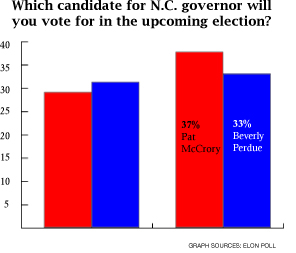
The governor’s race also remained close, with 37 percent backing the Republican Party and 35 percent supporting the Democratic Party.
“At this time, it appears that the three major races in North Carolina are going to come down to the wire,” Bacot said in September. “While the public has not made a final determination among the candidates, nearly everyone can agree that the economy is the major issue in these upcoming contests.”
October 2008 Findings
The most recent poll conducted involving candidate preference took place Sept. 29-Oct. 2, where a majority of the 477 North Carolinians questioned said they blamed the GOP for the nation’s economic woes.
This poll revealed that the race for the White House was still neck-and-neck, with 39 percent of residents surveyed supporting the Republican Party and 39 percent backing the Democratic Party.
But differences became more apparent when respondents were asked who would manage the economy better: 44 percent favored Obama compared to 42 percent for McCain. Seven percent said neither candidate.
“North Carolina, following the national trend, is leaning Democrat for president,” Bacot said. “Should this pattern prevail, the result would be a startling change in state presidential politics for more than one reason. Not only have the Democrats failed to win North Carolina in over thirty years, such a victory would mark a major milestone for the black community here and throughout the South.”
Perdue was supported by 33 percent for governor, while McCrory was supported by 37 percent.
Ahmed Fadaam visited Janna Anderson’s Reporting for the Public Good class on Oct. 24 to talk to her class about his experiences as a journalist. Fadaam became interested in journalism after his career as an artist was shattered because of the American invasion of Iraq.
by Andie Diemer
Oct. 23, 2008
“Have you ever seen a man die in front of you? Are there bad memories you still have in your mind that you remember just like yesterday?”
Iraqi artist and American public-radio journalist Ahmed Fadaam asked the students in a reporting class at Elon University if they have ever had a bad experience. No student in the 18-person class was able to say, “Yes,” each unable to compare any experience they had ever encountered to the horrific events Fadaam had been describing.
He said just because there are differences in each society doesn’t mean there can’t be a partnership between America and Iraq. But he added that the chances of this happening soon are minimal, as governmental hurdles and ignorant attitudes make it seem impossible to have honest, equal communication. He said because of the conflict in Iraq it is difficult for outside information to trickle into the country, even with more media now proliferating there.
He explained that when Saddam was in power there were just three TV stations and two newspapers, all government-controlled. In the past few years, there has been a surge to around 70 TV stations and more than 150 papers now. But each media outlet is tied to one tiny slice of the political spectrum, making it difficult for the public to decipher which information is correct, and he explained that this has caused confusion for the Iraqi population. “There is no objective, neutral reporting,” he said.
He said most Iraqis’ exposure to Americans is limited to experiences with American soldiers, so they believe all Americans are aggressive and want to be involved in the war. “We need to tell the Iraqis there’s a different between the American administration and the Americans,” he said. “It’s not an easy job to be a journalist in Iraq.”
He told Elon journalism students that American media organizations take a “negative-news” approach, highlighting deaths and destruction to sell stories. They neglect the other side of Iraqi society, which is smart and capable of building. Since the war in Iraq has continued for more than five years now, reporters are no longer paying attention to the details, he said. In early 2003 a story involving a car bomb would be covered thoroughly; now these occurrences have become so routine some editors won’t even publish a story unless at least five deaths have been racked up. “It’s just like yesterday, just like the day before, just like two years ago,” he said.
Fadaam is best known for his award-winning radio stories on “Ahmed’s Diary” (http://thestory.org/special-features/ahmed-s-diary), which depict his experiences in Baghdad on NPR. He credits his background in fine art as giving him the tools to become a successful journalist. He explained that the curiosity and attention to detail he used as a figurative artist, when he worked with clay, marble and stone, carried over to his career in reporting. “The more you work, the more details you create,” he said. “I think it’s relatively the same.”
After receiving a bachelor of arts, master’s of fine arts and doctorate in fine arts, Fadaam was a professor at Baghdad University in Iraq and a sculptor. “Art was my life at that time,” Fadaam said. “I couldn’t imagine chasing stories. I was locked into my own paradise of imagination.” But war changed his circumstances; a bomb destroyed a school where he was teaching. In 2003 he began working as an interpreter and fixer for NPR’s The Connection.
He also worked as a Baghdad reporter for Agence France-Presse and for The Story, with Dick Gordon for WUNC North Carolina Public Radio and American Public Media. But it soon became dangerous.
He was accused by some Iraqis of being a “blood traitor,” or someone who reports on the news to sell it for a profit, literally exchanging blood for a paycheck. But he said he can’t let accusations like these bother him because there is so much at stake and more than just people lost within the conflict. “As long as you’re doing your job then it’s not important,” he said.
His family started receiving death threats because he worked in the media. His wife and two children moved to Syria, where they would be safer, and Fadaam secured a temporary visa to visit the U.S. and work. Fadaam was hired as a newsroom supervisor in the Baghdad Bureau at the New York Times. He worked in New York for a short time after moving to America earlier this year, and is now spending time in North Carolina, working and visiting universities to talk with journalism and art students.
He is spending several weeks at Elon, where he is creating a sculpture to thank the university for hosting him and allowing him to speak in classes. Tom Arcaro, professor of sociology at Elon, arranged Fadaam’s visit and found a nearby space for him to work. The sculpture represents the plight of most women in the Middle East as they struggle to escape the tyranny expressed against them by their culture. Fadaam said he has enjoyed getting his hands into clay and creating again, as he works on this project, but his mind is never far removed from thoughts of his family in Syria and his people in Iraq.
He said the war has “destroyed” Iraq. Access to basic human needs such as power and water are far worse than at the time of Saddam. The Iraqi Museum, which contained important relics reflecting more than 5,000 years of human history, was decimated. “It’s a loss for all humanity,” he said. “Not just Iraq.”
He blames the lack of direct contact between Americans and Iraqis as the reason the wounds that have been created seem impossible to heal. He said while most Iraqis want Americans to leave, they also want it to be accomplished the right way. “[The Americans] started something; they should finish it,” he said. “They broke something, they should fix it.”
Fadaam pushes for an open channel that will establish a forum for each society to talk to each other, away from government interferences, people to people, individual to individual. But this would require the Americans taking the time to get to know Iraqi culture first-hand and the Iraqis taking the time to get to know the true American culture first-hand.
“How can we understand life if we know nothing about each other’s cultures?” he said. “If you don’t understand how they think, how can you deal with them?” He urged the students to learn more about how Iraqis think, live life and face their current problems.
“If you feel the pain you can talk about the wound,” Fadaam said. “Break this bond. We’re all human; we just speak different languages, that’s all.”
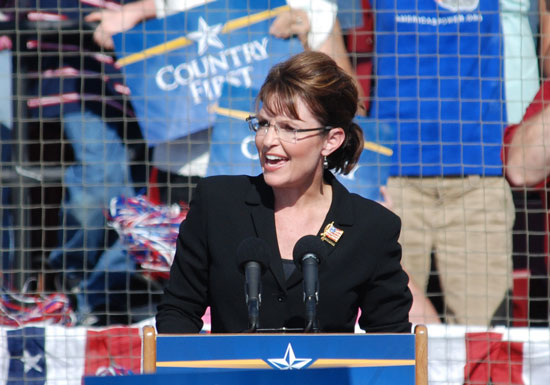
Alaska Gov. Sarah Palin addressed the Elon community at a rally Thursday. She talked about what the country could expect to see in a McCain-Palin administration. Photos by David Wells.
After Sen. Elizabeth Dole and country music star Hank Williams Jr. kicked off the “Road to Victory Rally,” Republican vice presidential candidate Sarah Palin joined them on the stage around 2:45 p.m. Thursday at Latham Park.
As thousands of people crowded the stadium and perimeter, the “straight-talk express” thanked the community for welcoming her before paralleling the Elon Phoenix to her running mate, Republican presidential candidate John McCain.
“I hope you all got to watch last night’s debate because the man from Phoenix proved once again that he is our best choice to be our next president,” Palin said. “Last night everyone in America got a look at the choice we face.”
This choice, she said, is between a politician in government and a true leader who puts his faith in the American people, McCain.
“It’s a choice between a candidate that will raise your taxes and the other choice is a true leader,” she said. “John McCain is going to Washington to work for Joe the Plumber and so many of you that own small businesses.”
She said people like Joe the Plumber and other small-business owners are the backbone of the American economy and that is why a McCain-Palin administration would be the best choice for America.
“Our opponent wants to raise taxes because he thinks like that other Joe,” she said, referring to Democratic vice presidential nominee Joe Biden. “They think government is the solution. I disagree with that. Government too often is the problem and we need government put back on your side.”
Only then, she said, will businesses and families can keep more of what they produce and earn.
“That’s how jobs are created and our economy [gets] moving again,” Palin said.
She said the election is a race between two tickets, one of inspiring words and another of trust-worthy deeds that come from McCain. To Palin, the deeds are greater than empty words and promises.
“Now, North Carolina, the choice is yours to make,” she said. “I’m here to ask you, are you ready to help us carry this state to victory? Are you ready to make John McCain the next president of the United States? And are you ready to send us there to shake things up in Washington?”
TAKING ON OBAMA
After a chant of “USA! USA! USA!” erupted, Palin urged the audience to look toward the future and keep a McCain-Palin administration in mind.
“So North Carolina, there is so much at stake in this election,” she said.
Her campaign is for the kids in the audience and the next generation of Americans. Obama’s campaign only looks to the past and points fingers, Palin said.
“But John McCain and I are joining you and looking to the future because that’s where we find solutions,” Palin said. “They look to the past because they think they’re running against the current administration.”
If Obama wanted to run against President Bush, he should have run for office four years ago, she said.
“This year the name on the ballot is John McCain and America knows John McCain is his own man,” Palin said. “He is a maverick.”
She said McCain is the only man who talks about the wars that America is fighting and isn’t afraid to use the word victory. Obama, she said, goes on in every speech about the wars America is fighting but does not express a desire to win them.
“It would be nice for him to say he wants to win,” Palin said.
Through the adversity in McCain’s life he knows how to overcome tough challenges, she said.
“He is exactly the kind of man I want as commander in chief,” she said before taking a moment to honor audience members who have or are currently serving the country. TRACK RECORDS
Because she and McCain have been able to do this in the past, it will be possible to allow tax relief to every American and every business, she said. In turn, this would allow small-business owners to produce more, keep more money and provide more jobs.
“We don’t just talk the talk, we can walk the walk,” she said. “It’s not mean-spirited and not dirty campaigning when you call someone out on their record.”
By eliminating taxes and other wasteful spending Palin said she was able to pour some money back into the Alaskan economy.
“You gotta do what you gotta do to best serve the people that have hired you,” Palin said.
She said the same methods would work for the country: getting spending under control, going back to the basics and getting the government back on the side of the people.
“In a McCain-Palin administration I promise you we will never forget that we will be there, in Washington, D.C., working for you, the people of America,” Palin said.
She said so many people living in America in communities like Elon are not asking for much, they simply want a good job in their hometown, a pro-growth agenda and spending control in Washington. That is how the economy gets moving again, she said.
ADDRESSING POLICIES
Palin said someone with experience, courage, good judgment and trustworthiness is necessary to bring America to its feet.
“Now more than ever we need someone tough who is ready to lead on day one,” she said. “We need a leader with a bold plan of action to take this country in a new direction and that person is John McCain.”
It is in these times of great hardships and worry that McCain will institute a plan for American families to keep their homes and help retirees keep their savings.
Palin said she plans to do something about those “other” people who have been greedy and corrupt and who have lost the money of hard-working Americans.
She said a McCain-Palin administration would have a plan to help students pay for college and ensure that all Americans are able to afford health care.
“Together, John McCain and I will complete the work of education reform so that every child in America has a chance and every parent in America has better and more choices in how we educate our children,” she said.
John McCain has the backbone and guts to confront the $10 trillion debt that has been accumulated by the federal government. It’s not fair to pass that onto the next generation, Palin said.
This includes putting a spending freeze on everything except the most vital aspects and balancing the federal budget by the end of their first term.
“You have to do that in [your] business and homes, why does the federal government doesn’t think it has to?” she said. STANCE ON ENERGY
Palin said McCain will also work to end 30 years of failed policies that have been set for energy independence and will work to develop new as well as tapping into old sources.
McCain would adopt an “all-of-the-above approach,” which would include not just gas and oil, but wind, hydro, geothermal, biomass, clean coal and nuclear forms of harvesting energy. These would create new jobs, where they are needed most, along the way.
She said drilling safely in America and offshore is what needs to be done.
Spending billions of dollars into other countries, some of which use energy as a weapon against America, is not what the administration should be doing, Palin said.
“That money needs to be circulated right here creating jobs for all of you,” Palin said. “It is for the sake of our national security and economic prosperity that we have American energy resources brought to you by American ingenuity and brought to you by American workers.”
ASSISTING SPECIAL NEEDS
Aside from energy and government reform, Palin said another large portion of her time in office would be spent helping families with special-needs children.
“Children with special needs can inspire a special love. We can learn more from them than they can learn from us,” she said. “They are not a problem, they are priority.”
After commending a sign in the crowd that read “Extra chromosomes means extra love,” Palin talked about the special challenge in her life, her son Trig, who was born with Down syndrome.
“Even before Trig was born I have sought for more funding for our students with special needs, understanding too that they deserve the opportunity for special education,” she said. “[I’ll] make sure these families have a friend and an advocate in the White House because John and I have a vision where in America every child is cherished.”
As security was escorting a rowdy protester out, Palin exclaimed that “Maybe he doesn’t need to go, but maybe he needs to stay and learn a little bit from all of you.”
NORTH CAROLINA’S ROLE
“North Carolina, on Nov. 4, it’s gonna come down to what we believe in and the choice that we have to make comes down to what we believe in,” she said.
She said she and McCain have a similar vision to what Ronald Reagan believed in.
“We believe in the forward movement of freedom, not the cost and expansion of government,” she said. “The best of America is not all gathered in Washington, D.C., it’s found here in the kindness and goodness and courage of real town America, where the families ask the government to be on their side, not in their way.”
She said the people who grow food, teach children and protect freedom for America is where the kindness, goodness and wisdom of the country is found.
“We believe in the promise of this country and all the opportunities we wish for ourselves,” she said. “We believe that America is not the problem, it is the solution. We don’t have to apologize for being Americans. We’re not a perfect nation, we learn form our mistakes.”
She said there is man who is inspiring, ready, willing, and able to lead the nation.
“There is only one man in this race who has ever really fought for you,” Palin said. “He understands that the virtues of freedom is worth fighting for and he has the courage to keep fighting for you. Help me elect John McCain.”
Following the spiraling fall of the United States economy, the presidential debates on Oct. 7 at Belmont University in Nashville, Tenn. focused on the economic crisis at hand.
The second of three debates, which was conducted in a “town meeting” format, was moderated by Tom Brokaw of NBC News.
Republican candidate Sen. John McCain and Democratic candidate Sen. Barack Obama both spoke about their approach to healing the economy, who should be appointed as treasury secretary and how they would help those that have been impacted.
“I think everybody knows now we are in the worst financial crisis since the Great Depression,” Obama said. “I believe this is a final verdict on the failed economic policies of the last eight years, strongly promoted by President Bush and supported by Senator McCain, that essentially said that we should strip away regulations, consumer protections, let the market run wild and prosperity would rain down on all of us.”
He said it needs to be ensured that the recently-passed rescue package will function correctly, more CEOs will be cracked down on, tax cuts will be given for the middle-class, homeowners will be assisted and that the health and energy systems will be fixed.
“It means help for homeowners so that they can stay in their homes,” he said. “It means that we are helping state and local governments set up road projects and bridge projects that keep people in their jobs.”
McCain said energy independence and not increasing taxes are the keys to success.
“We obviously have to stop this spending spree that’s going on in Washington,” McCain said. “We’ve got to have a package of reforms and it has got to lead to reform prosperity and peace in the world. And I think that this problem has become so severe, as you know, that we’re going to have to do something about home values.”
If elected president, McCain said he would require the secretary of the treasure to buy up bad home loan mortgages and renegotiate the new values to make sure they can stay in their homes.
He said creating jobs and fixing the economy would not happen until home values in America are stabilized.
“It’s my proposal, it’s not Senator Obama’s proposal, it’s not President Bush’s proposal,” McCain said. “But I know how to get America working again, restore our economy and take care of working Americans.”
Health and energy policies, entitlement reform, Social Security, Medicare, America’s stance in the world as a peacemaker and environmental issues were also touched upon.
“You need somebody working for you and you’ve got to have somebody in Washington who is thinking about the middle class and not just those who can afford to hire lobbyists,” Obama said.
They also sounded off on the humanitarian intervention, Pakistani sovereignty, reorganizing Afghanistan’s strategy, how they view and would apply pressure to Russia for humanitarian issues and their actions if Iran attacked Israel while they were in office.
“Americans are angry, they’re upset and they’re a little fearful,” McCain said. “It’s our job to fix the problem.”
Republican vice presidential candidate Alaska Gov. Sarah Palin spoke at a rally in Waukesha, Wis., at the Center Court Sports Complex on Oct. 9. Palin is expected to speak at Elon University on Oct. 16. Photo courtesy of Michael Sears/Milwaukee Journal Sentinel/MCT.
by Andie Diemer
Oct. 13, 2008
Republican Vice Presidential Candidate Alaska Gov. Sarah Palin is scheduled to speak Thursday at Elon University, Robert Simpson, chairman of Alamance County Republican Party, told the Burlington Times-News.
While details are still being worked out, preparations around campus point to a 3 p.m. event at Latham Park baseball stadium on campus.
Student Body President Chase Rumley said that while it hasn’t been confirmed, it would reflect very positively on Elon to have Palin here, especially considering Former President Bill Clinton visited in the spring.
“It will be interesting to see if her speech is more student or community focused and who her message speaks to more,” he said. “I think everyone will be respectful.”
Nick Ochsner, president of College Republicans, said he was not able to confirm the event until a press release was published by the campaign.
Palin will also speak on Thursday at 8 a.m. at Bangor International Airport in Bangor, Maine and again at 10 a.m. at United Sports Training Center in Chester County, Pa.
Both events are open to the public and free.
She will also be making an appearance at an event in Greensboro later that evening.
ABC News Senior Executive Producer Michael Clemente talked a Reporting class at Elon University on Oct. 10 to discuss his role in the industry and why news is important.
“I’ve sort of lived through it all,” Clemente said, referring to the growth, expansion and breadth of the television news industry.
Watch him speak about how how he broke into the industry, a topic and career goal many students in the class were interested.
Following President George W. Bush’s signature on a $700 billion bailout bill to help keep America’s economy afloat Friday, the U.S. financial situation began to envelope the rest of the world. On Monday, stock prices plummeted, both nationally and internationally, causing many to reevaluate the world’s banking system.
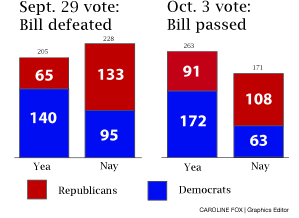
Even though the rescue package bill, which passed 263-171, was passed in an effort to protect Americans financially, it couldn’t combat the snowball effect of a crumbling economy.
The Dow Jones Industrial Average closed below 10,000, which is the first time it has hit that low in almost four years. It fell 800 points before a late rally pushed it down 369.88 points, at 9,955.50.
The Dow first fell to 10,000 on March 16, 1999.
The Treasury Department set temporary guidelines for hiring money managers to oversee the bailout bill and prevent conflicts from ensuing on Monday as well, according to CNN. Many analysts said they do not foresee many dramatic changes in the short term, though the bill should be more effective in the long run.
Last week, President Bush said the $700 billion rescue package will help restore assurance in America’s financial system.
“It’s going to take a while to get in place a program that, one, is effective and, two, doesn’t waste taxpayers’ money,” Bush said. “It’s going to take awhile to restore confidence in the financial system.”
Since banks are reluctant to administer loans to one another, companies and individual consumers, the rescue package will aim to absorb bad assets, like troubled mortgage bonds. This will allow banks to begin loaning money again.
CNN reported that the Federal Reserve also took action to keep the financial crisis from growing out of control by establishing an additional $300 billion available to banks in exchange for damaged assets on Monday. While this number raises the amount available to $600 billion, they said it may continue to expand to $900 billion.
The Federal Reserve also established short-term loans in an effort to keep global financing moving.
But all of these efforts combined didn’t stop depositors from Europe, Mexico and Brazil from attempting to escape the stock markets.
The German government officials announced Sunday they would backstop all bank deposits after a German mortgage mender rescue plan failed, causing the public to infer economic problems outside of the United States were much more severe.
Many European exchanges also posted some of their worst losses in history. London’s FTSE fell 7.9 percent, France’s CAC-40 index fell 9 percent, Russia’s stock index fell by 19 percent before being halted and Germany’s DAX-30 fell 7 percent, CNN said.
Indonesia’s stocks slumped by 10 percent while Asian stocks fell by 5 percent.
In Asheville, N.C., on Monday, Democratic presidential nominee Barack Obama called for a new federal economic stimulus package.
He said Monday’s stock market drop “is a reminder that the rescue package that was passed last week is not the end of our efforts to deal with the economy,” Obama said. “It is just the beginning.”
He said a new stimulus would encompass relief from high gas and food prices, assistance for both the local and state governments to maintain payrolls and extend unemployment insurance.
While traders shifted capital to safer outlets, such as gold and Treasury bonds, oil prices actually fell 6.5 percent from the record high in July to $87.81.
Even though it may take time to see the economy become stronger, Bush urged believing in the moves the government was making.
“One thing people can be certain of is that the bill I signed is a big step toward solving this problem,” he said.
This Saturday marks the official launch of the Ever Elon Campaign, a comprehensive program that has been almost two years in the making and will focus on the school’s endowment and funding as well as providing funds for the completion of three buildings on campus.
At Tuesday’s College Coffee, a preview of the campaign was revealed to educate the community on how it can become involved and help shape the future of the university.
The program, which has been backed by Elon’s Board of Trustees, will work to continue building and creating new opportunities at Elon. These include getting more students to study abroad, awarding more research grants for student-faculty collaboration and constructing a larger Convocation Center that will be able to house everyone on campus.
Chuck Davis, director of the Ever Elon Campaign, said the campaign’s endowment goal will be released Friday. Elon’s current endowment is about $82 million.
“Our campaign priorities for endowment are very much related to supporting students,” Davis said.
Whether this is through merit- or need-based aid scholarships or study abroad grants, Davis said this campaign will impact everyone, even if the direct funds are not going toward student activities.
“Supporting our faculty has a direct correlation on student experience in the classroom,” Davis said. “We’re trying to endow new professorships to ensure the experience for our students in the classroom is always cutting edge and top notch.”
While growing the endowment is the focus of the campaign, Ever Elon will also work to finish building Lindner Hall as well as create a multi-faith center adjacent to the church and a new athletics facility.
Gifts began being counted on June 1, 2006. From that time on a diverse committee, which encompassed students, faculty, staff and board members, worked to create the nuts and bolts of the campaign. Everything from how to “count” a gift to minimum donation amounts was tackled.
Current results of Elon’s endowment include buildings, such as Moseley, Koury Business Center, the Academic Village and Belk Library, and other amenities like scholarship programs. Donors can opt to specific what they would like their money put towards, such as athletics or abroad experiences.
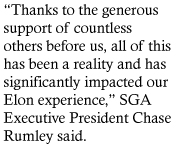
“Thanks to the generous support of countless others before us, all of this has been a reality and has significantly impacted our Elon experience,” SGA Executive President Chase Rumley said.
Rumley said the visions to improve campus can materialize, but only through donations from the Elon community, including students, their families, faculty, staff and friends.
“This campaign is about every single person,” he said. “It’s about everybody chipping in and making a difference. Every gift from every student, regardless of size or designation, counts for the campaign.”
After two students were hospitalized last weekend for internal bleeding, the Health Department said they still have not been able to find any conclusive origin or diagnosis of the illnesses, according to Assistant Vice President for Student Life Jana Lynn Patterson.
Patterson said after having a phone conference with the county and state officials Friday, there is still no consistent pattern of where the students ate either on or off campus or where they live.
The Health Department said there is no pattern of food-borne related illnesses, Patterson said. However, the Health Department and state lab are still conducting cultures taken from the students and the results were not available at press time.
After being released from the hospital Sept. 28, juniors Mike Milano and Dan Rickershauser have visited the doctor once. Milano is visiting for another checkup today and Rickershauser has a CAT scan planned a month from now.
Both said they are feeling healthy and recovered.
Patterson said the state official for communicable diseases said on Friday there was no need to alarm, since the baseline numbers for patients who presented had a broad range of similar gastrointestinal symptoms are around the same for this time from 2007-2008 and 2008-2009.
There were only 72 cases with the same symptoms during the same time period this year, which is only a one percent increase, Patterson said.
“[This] is not significant given the size of our residential population,” she said.
Currently, the Health Department is talking to about 20 students. Most of these were contacted through the Health Department’s own investigation and they did not receive medical treatment on campus.
While a student was hospitalized a few weeks ago for a positive strain of salmonella bacteria, the Health Department said there is no known connection between the instances. That student is now fully recovered, Patterson said.
“The Health Department has not indicated or recommended any changes in food procurement, handling, storage or preparation for ARAMARK,” Patterson said.
For precautionary measures, Physical Plant cleaned and sanitized a few areas on campus, where some of the sick students live on campus.
Patterson said she has talked about cleaning procedures to students that may have been sick and live off campus to ensure their health.
She said the county health department is no longer requiring the school to report all cases of similar symptoms to the Health Department for follow up, but that the administration will be taking a modified protocol for the next two weeks instead.
“Our protocol will be to report to the Health Department if a patient presents with symptoms that meet more stringent criteria,” she said. “We have been reporting all cases of the specified symptoms this week, regardless of severity.”
She said in the event that more severe symptoms appear the staff will forward a sample onto a lab for normal testing that that the Health Department will be notified so they can evaluate the sample as well.
The Burlington Times-News court reporter Keren Rivas talked to Janna Anderson’s Reporting for the Public Good class at Elon University on Oct. 6 about covering crimes, courts and government.
She spoke extensively about how to carefully handle covering these types of stories, since they are atypical from the standard news story and require an extra touch.
Watch what Rivas has to say about learning court jargon and dealing with lawyers who want nothing to do with the media.
 by Andie Diemer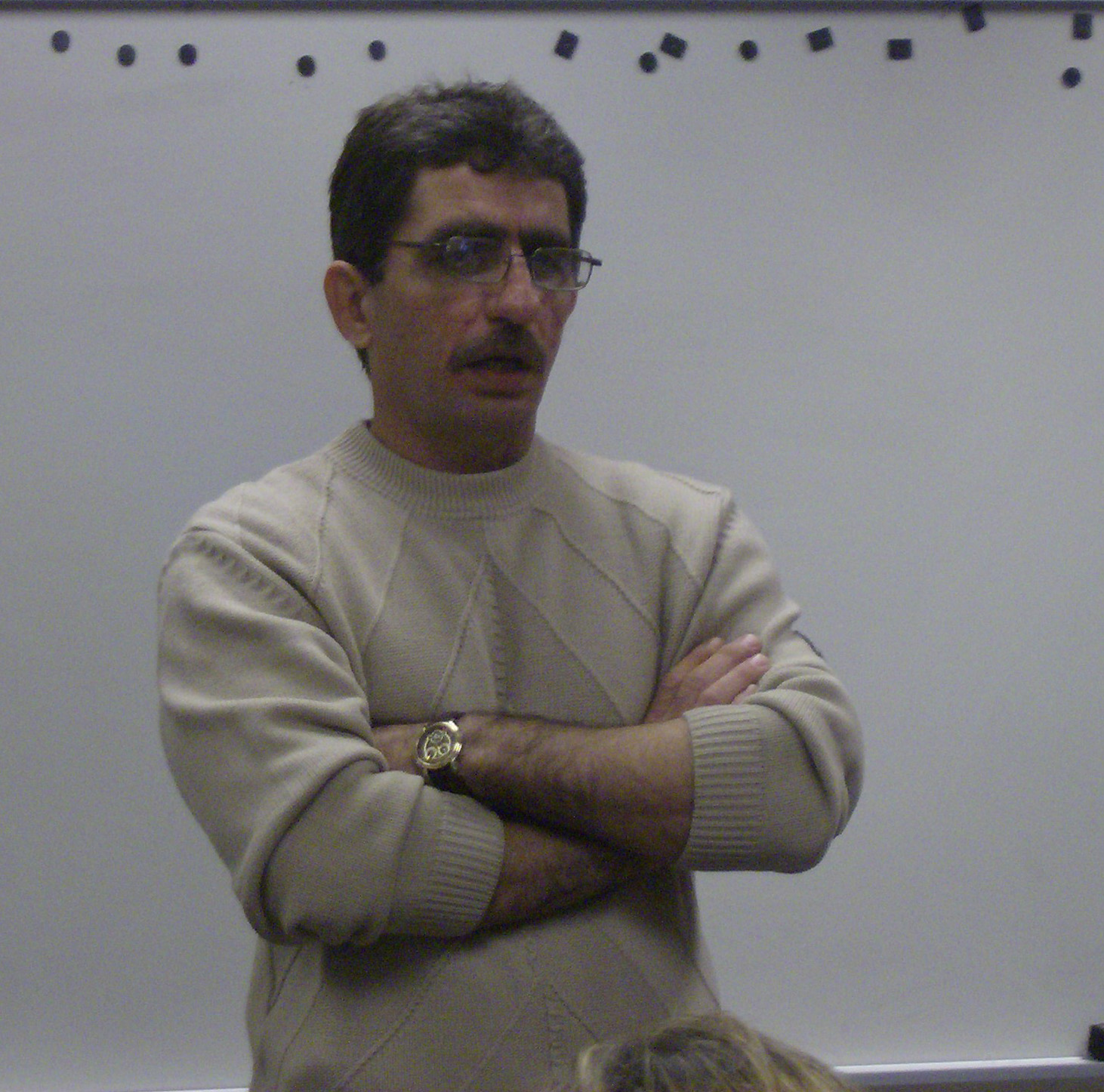
 TRACK RECORDS
 STANCE ON ENERGY
 He said it needs to be ensured that the recently-passed rescue package will function correctly, more CEOs will be cracked down on, tax cuts will be given for the middle-class, homeowners will be assisted and that the health and energy systems will be fixed.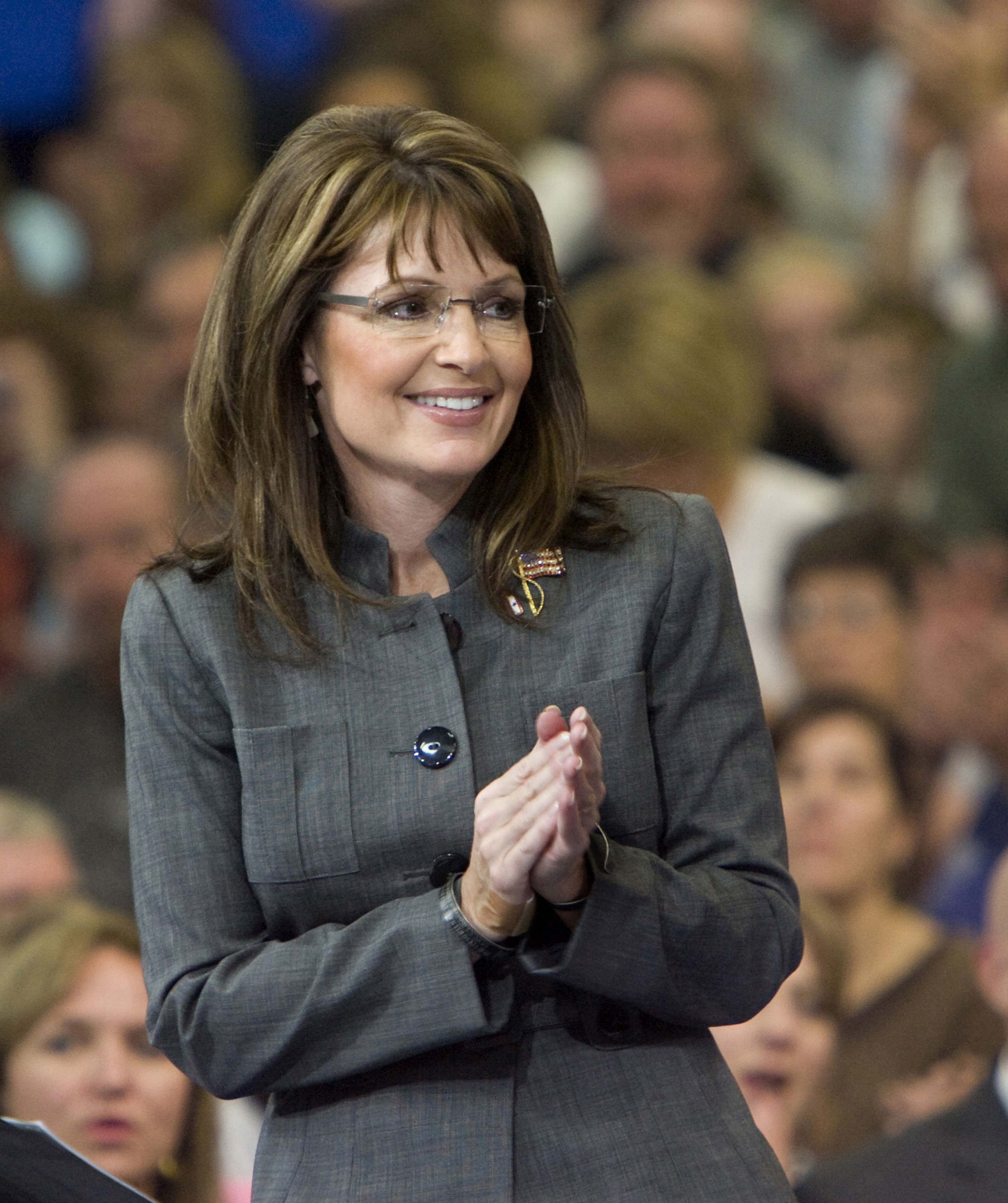
 by Andie Diemer
 Chuck Davis, director of the Ever Elon Campaign, said the campaign’s endowment goal will be released Friday. Elon’s current endowment is about $82 million.
 andie diemer